

You are running two inventories at once
Most inventory tools were built for people who buy finished products and resell them. Makers do not work that way. You buy wax, wicks, oils, jars, and labels, then you turn them into candles. So you are tracking two things at the same time: the raw materials you consume, and the finished products you sell. When you make a batch, materials should go down and finished stock should go up, in one step.
That is the job. A spreadsheet cannot do it without constant manual math, and most cheap apps ignore materials entirely.
Make a batch, and both sides update
Stockria uses bills of materials, so each product knows what it is made of. Record that you made 24 candles, and Stockria draws down the wax, wicks, and jars automatically and adds 24 finished candles to stock. You always know how many you can still make before you run out of a material, and what to reorder first.
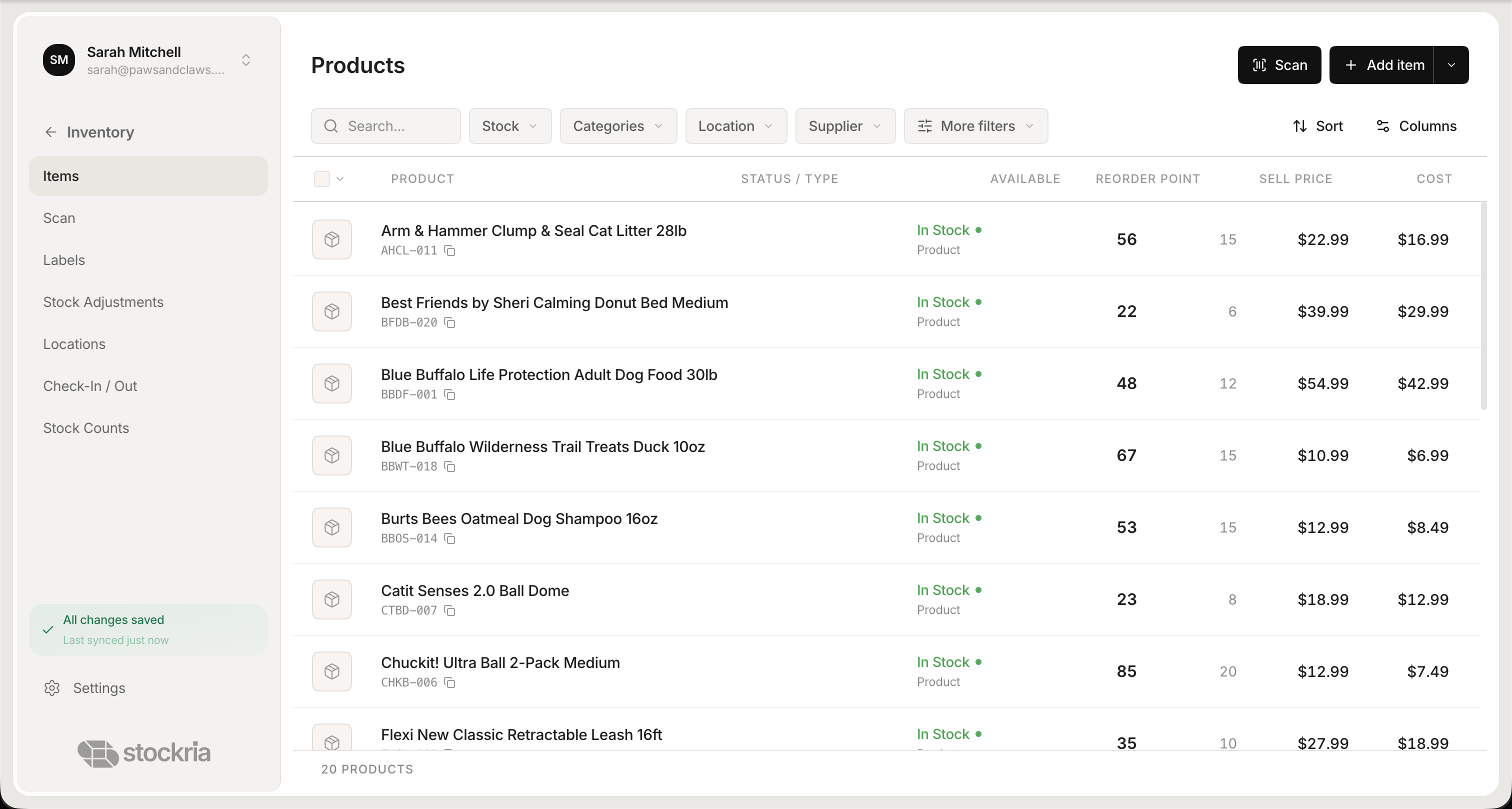 Stockria in action: materials and finished goods in one place, with stock levels, cost, and reorder points.
Stop overselling when you sell in more than one place
The fastest way to upset a customer is to sell them something you do not have. It happens the moment you sell in two places at once: Etsy plus a market stall, or Etsy plus your own Shopify site. One channel does not know the other made a sale, so your counts drift and you oversell.
Stockria keeps live stock in step across Shopify, Amazon, Square, Wix, and Etsy. Sell a candle at a Saturday market and the Etsy listing drops too. Sell one on Etsy and every other channel knows. One source of truth, everywhere you sell. For a full breakdown, see how to stop overselling on Etsy.
Work offline at markets and fairs
Markets and craft fairs are exactly where signal dies, and exactly where you are making sales. Stockria is offline-first, so you can scan, sell, adjust, and count with no internet. When you are back online, everything syncs. Cloud-only maker tools cannot do this, and it is the difference between guessing your stock on Monday and knowing it.
Know what each product actually costs
If you price on a gut feel, you are probably leaving money on the table or losing it on some products without knowing. Stockria tracks the cost of every material and rolls it up through your bills of materials, so you can see the true cost of a finished product and set a price with a real margin instead of a hunch. Not sure where to start? Try the handmade pricing calculator.
Set it up in an afternoon, free
You do not need a consultant or a weekend. Start free for up to 250 items with every feature included, no credit card. Build clean product codes with the free SKU generator, and work out reorder points with the reorder point calculator. If your stock lives in a spreadsheet or another tool, send it to us and we set it up for you, free.
You can also see it in action first, no signup: real screenshots of the app, plus a quick demo with the founder if you want one.
Common questions from makers
Is Stockria good for handmade and craft businesses? Yes. It handles the two-inventory problem that makers have, materials and finished goods, with bills of materials on every plan. It also does multichannel stock sync, offline mode for markets, barcode scanning, and purchase orders.
How is it different from other inventory tools? Craftybase is strong on detailed cost accounting and is billed by monthly order volume. Stockria is flat-priced, starts free, works offline, and syncs stock across channels, while still doing bills of materials and cost tracking. See the full Stockria vs Craftybase comparison.
Does it work for candles, soap, jewelry, and other crafts? Yes. Anything made from materials fits the bill-of-materials model. There are detailed guides for candle and soap makers, jewelry makers, ceramics and pottery makers, apparel and clothing makers, and leather goods makers.
Can I sell at markets without internet? Yes. Stockria is offline-first and syncs automatically when you reconnect.
What does it cost? Free for up to 250 items. Paid plans are flat: $19/mo for unlimited items, and your price only moves when you add users or locations, never because you sold more.