

Why techniques matter more than tools
The best inventory software in the world will not help if you are using the wrong approach for your business. Inventory management techniques are the strategies behind the system. They tell you how much to order, when to order, and which products deserve the most attention.
You do not need to use all of these techniques. Most small businesses benefit from picking two or three that match their situation.
Just-In-Time (JIT)

JIT means ordering inventory to arrive right when you need it, not weeks or months in advance. The goal is to minimize the amount of stock sitting in your warehouse at any given time.
When it works: Reliable suppliers with short lead times. Products with steady, predictable demand. Businesses with limited storage space.
When it does not: Unreliable supply chains. Highly seasonal demand. Products with long manufacturing lead times.
JIT reduces carrying costs and frees up cash, but it leaves little room for error. If a shipment is delayed, you are out of stock immediately. Many small businesses use a modified JIT approach with a small safety buffer rather than pure just-in-time.
Economic Order Quantity (EOQ)
EOQ calculates the ideal order size that minimizes the total cost of ordering and holding inventory. The formula balances two opposing forces: ordering frequently in small quantities (high ordering costs) versus ordering rarely in large quantities (high holding costs).
The formula: EOQ = square root of (2 x Annual Demand x Order Cost / Holding Cost per Unit per Year)
For example, if you sell 1,000 units per year, each order costs $25 to process, and it costs $5 per year to store each unit: EOQ = square root of (2 x 1000 x 25 / 5) = square root of 10,000 = 100 units per order.
EOQ gives you a starting point. Adjust it based on supplier minimum orders, bulk discounts, and storage constraints.
ABC Analysis
ABC analysis ranks your products by value or importance and assigns management intensity accordingly.
- A items (top 20 percent by value): Tight control, frequent counts, careful forecasting. These items have the biggest financial impact.
- B items (next 30 percent): Moderate control. Review monthly, count periodically.
- C items (bottom 50 percent): Simple controls. Order in bulk, count infrequently, use generous reorder points.
This technique prevents you from spending equal time on a $500 product and a $5 product. Focus your energy where it counts.
Safety Stock
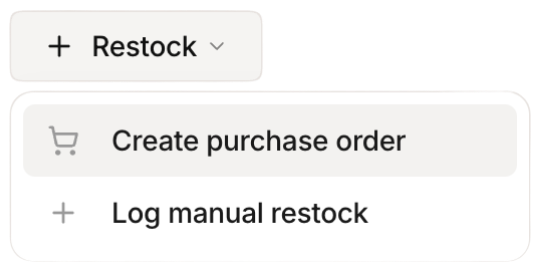 Stockria in action - Restock items with one tap when stock runs low.
Safety stock is the buffer inventory you keep to protect against unexpected demand increases or supply delays. It is insurance against uncertainty.
A simple formula: Safety Stock = (Maximum Daily Sales - Average Daily Sales) x Maximum Lead Time
If you sell up to 20 units on your busiest days, average 12 units daily, and your longest supplier lead time is 10 days: Safety Stock = (20 - 12) x 10 = 80 units.
Every product does not need the same safety stock level. Your A items need more protection because stockouts on those products cost the most. C items might need very little.
Min-Max Method
The min-max method is the simplest reorder technique. For each product, you set a minimum quantity (the reorder trigger) and a maximum quantity (the most you want on hand). When stock drops to the minimum, you order enough to bring it back up to the maximum.
Min (reorder point): Average daily usage multiplied by lead time, plus safety stock.
Max: The most you want to store based on demand, storage capacity, and budget.
Order quantity: Max minus current stock on hand.
This method is easy to implement, easy to understand, and works well for businesses with relatively stable demand.
Choosing the right techniques for your business
Start by asking yourself these questions:
- How reliable are your suppliers? If lead times are unpredictable, safety stock and min-max are essential. JIT is risky.
- How many SKUs do you manage? With hundreds of products, ABC analysis helps you prioritize your effort.
- How tight is your cash flow? EOQ and JIT help minimize the cash tied up in inventory.
- How seasonal is your demand? Highly seasonal businesses need strong forecasting paired with safety stock adjustments.
Combine techniques for the best results
Most successful small businesses use ABC analysis to prioritize, safety stock to protect against disruption, and either EOQ or min-max to determine order quantities. Start with these three, refine them over a few months, and add JIT elements if your supply chain supports it.