

What a reorder point is
A reorder point is the inventory level at which you place a new order with your supplier. Set it too high and you carry excess stock. Set it too low and you stockout before the new shipment arrives.
The goal is to trigger an order at the exact moment that gives your supplier enough time to deliver before you run out.
The formula

Reorder Point = (Average Daily Sales x Lead Time in Days) + Safety Stock
That is it. Three numbers multiplied and added. Let us break each one down.
Average daily sales is how many units you sell per day, averaged over a meaningful period. Use at least 30 days of data, more if your sales are seasonal.
Lead time is how many days it takes from placing the order to having the stock on your shelves. Include shipping, customs if applicable, and the time it takes to receive and shelve the items.
Safety stock is your buffer against variability. Demand fluctuates. Suppliers are sometimes late. Safety stock covers those surprises.
Calculating safety stock
A simple safety stock formula: (Maximum Daily Sales x Maximum Lead Time) - (Average Daily Sales x Average Lead Time)
This calculates the worst-case scenario minus the normal scenario. The difference is your buffer.
For many small businesses, a simpler approach works: keep 1 to 2 weeks of average sales as safety stock. Adjust up for critical items and down for items where a brief stockout is acceptable.
Example 1: Retail store
A clothing store sells an average of 4 units per day of a popular t-shirt. The supplier delivers in 7 days. Maximum daily sales have hit 6 units, and the longest lead time has been 10 days.
Safety stock: (6 x 10) - (4 x 7) = 60 - 28 = 32 units.
Reorder point: (4 x 7) + 32 = 28 + 32 = 60 units.
When stock hits 60 shirts, it is time to reorder.
Example 2: Food business
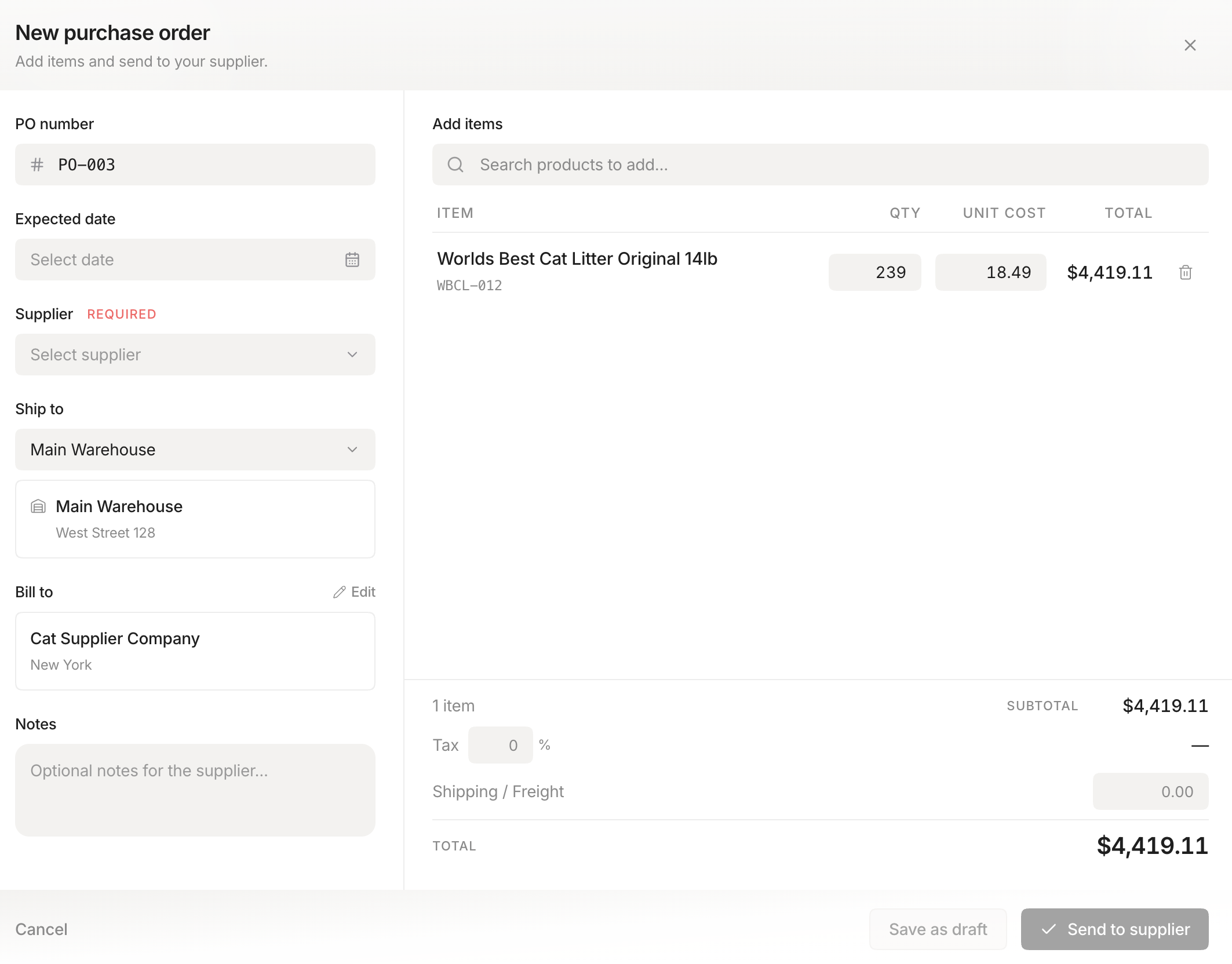 Stockria in action - Create and send purchase orders to your suppliers in seconds.
A bakery uses an average of 20 pounds of flour per day. The supplier delivers in 2 days. Maximum usage is 30 pounds on busy days, and the longest delivery has been 3 days.
Safety stock: (30 x 3) - (20 x 2) = 90 - 40 = 50 pounds.
Reorder point: (20 x 2) + 50 = 40 + 50 = 90 pounds.
Order more flour when you drop to 90 pounds.
Example 3: E-commerce business
An online store sells an average of 15 units per day of a phone case. The supplier is overseas with a 21-day lead time. Maximum daily sales are 25, and the longest lead time has been 28 days.
Safety stock: (25 x 28) - (15 x 21) = 700 - 315 = 385 units.
Reorder point: (15 x 21) + 385 = 315 + 385 = 700 units.
The long lead time and high variability result in a much higher reorder point. This is why businesses with overseas suppliers carry more inventory.
Adjusting over time
Reorder points are not set-and-forget. Review them quarterly or when conditions change. Sales trends shift, suppliers change lead times, and your tolerance for stockouts may evolve as the business grows.
If you consistently receive orders before hitting zero, your reorder point might be too high. If you stockout before deliveries arrive, it is too low. Track these patterns and adjust.
Automate it
Calculating reorder points for 5 products is manageable. For 50 or 500 products, you need software that monitors stock levels, calculates reorder points based on actual sales data, and sends alerts when it is time to buy. The formula does not change - the scale does.