

Why best practices beat improvisation
Most small businesses manage inventory reactively. They order when they run out, count when something seems off, and organize when they cannot find what they need. This approach works until it does not, usually at the worst possible time.
Best practices are not about perfection. They are about building simple habits that prevent the most common and costly inventory problems.
Practice 1: Use ABC analysis to focus your attention

Not all products deserve equal attention. ABC analysis divides your inventory into three groups:
- A items (top 20 percent by value): These represent roughly 80 percent of your inventory value. Monitor them closely, count them frequently, and forecast their demand carefully.
- B items (next 30 percent): Important but not critical. Review monthly.
- C items (bottom 50 percent): Low-value items. Manage with simpler rules and less frequent checks.
This keeps your effort proportional to the financial impact.
Practice 2: Maintain safety stock
Safety stock is the extra inventory you keep on hand to absorb unexpected demand spikes or supplier delays. Without it, any disruption leads to a stockout.
A simple formula: Safety Stock = (Maximum Daily Sales - Average Daily Sales) x Lead Time. You do not need exact numbers. Even a rough estimate protects you from the most common disruptions.
Practice 3: Count inventory regularly with cycle counts
Full warehouse counts are disruptive and time-consuming. Cycle counting is the alternative: count a small portion of your inventory every day or week so that over time you cover everything.
Count your A items weekly, B items monthly, and C items quarterly. This catches errors continuously without shutting down operations.
Practice 4: Set and review reorder points
Every product should have a reorder point that triggers a purchase order. Set these based on your average sales rate and supplier lead time, then review them quarterly.
Demand changes. Suppliers change. A reorder point set six months ago may no longer be accurate.
Practice 5: Standardize your receiving process
Create a checklist for receiving shipments: verify quantities against the purchase order, inspect for damage, record the receipt in your system, and put items in their assigned locations. Every shipment, every time.
Sloppy receiving is the number one cause of inventory inaccuracy. If the count is wrong from the start, everything downstream is wrong too.
Practice 6: Implement first-in, first-out (FIFO)
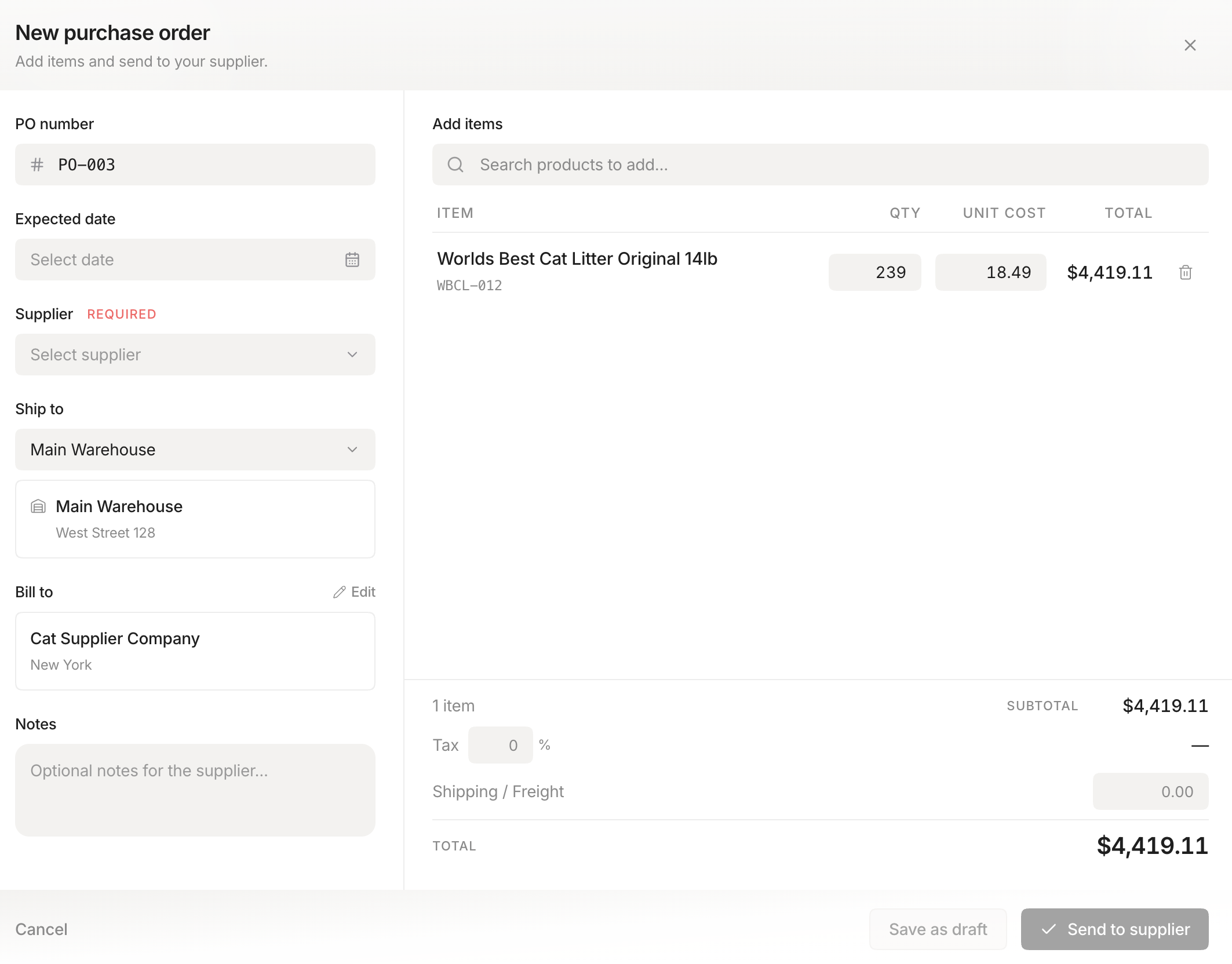 Stockria in action - Create and send purchase orders to your suppliers in seconds.
Sell or use older stock before newer stock. This prevents spoilage for perishable goods and reduces the chance of obsolescence for everything else. When restocking shelves, place new items behind existing ones.
Practice 7: Track key metrics monthly
Measure these four numbers each month:
- Inventory turnover rate: Cost of goods sold divided by average inventory. Higher means your inventory is moving faster.
- Stockout rate: The percentage of times a customer wanted something you did not have.
- Carrying costs: What it costs to store your inventory (rent, insurance, shrinkage, capital cost).
- Order accuracy: The percentage of orders shipped correctly.
You cannot improve what you do not measure.
Practice 8: Reduce lead times where possible
Shorter lead times mean less safety stock, fewer stockouts, and faster response to demand changes. Talk to your suppliers about faster shipping options. Consider keeping backup suppliers for critical items. Even reducing lead time by a few days makes a measurable difference.
Practice 9: Clean up dead stock regularly
Products that have not sold in 90 days are tying up cash and shelf space. Review your slow movers monthly. Discount them, bundle them with popular items, donate them, or stop reordering.
Dead stock does not get fresher with time. Act on it quickly.
Practice 10: Use technology appropriately
You do not need the most expensive software on the market. You need a tool that matches your current complexity. A spreadsheet works for 50 SKUs. Basic inventory software works for a few hundred. Advanced systems make sense when you operate multiple warehouses or sell on many channels.
The key is choosing a tool you will actually use consistently.
Putting it all together
Start with the practices that address your biggest pain point. If stockouts are your problem, prioritize safety stock, reorder points, and cycle counting. If cash flow is tight, focus on dead stock cleanup, ABC analysis, and lead time reduction. Build one habit at a time, and the compound effect will transform your operations.