

What makes wholesale inventory different
Wholesale inventory management shares the basics with retail - track what you have, know when to reorder, minimize waste. But the scale and structure are fundamentally different.
You buy in bulk. You sell in bulk. Your minimum order quantities are measured in cases, pallets, or containers rather than individual units. Your margins are thinner, so efficiency matters more. And your supplier relationships carry more weight because switching costs are higher.
Dealing with minimum order quantities

MOQs are the minimum amount a supplier will sell you. A manufacturer might require you to order at least 500 units, 10 cases, or a full container. This creates a constant tension between what you need and what you are required to buy.
When the MOQ exceeds your near-term demand, you have a few options. Negotiate with the supplier - especially if you are a regular customer, they may flex on quantities. Coordinate with other buyers - some wholesalers pool orders to meet MOQs. Accept the overstock - if the product is a steady seller, buying ahead is not always bad. It just ties up more cash.
The key is calculating whether the carrying cost of the extra inventory exceeds the price benefit of the bulk purchase. Sometimes ordering the MOQ is the cheapest option. Sometimes it is not.
Managing lot sizes and case packs
Wholesalers often deal in fixed lot sizes. You cannot order 73 units - you order 72 (a case of 6 dozen) or 80 (a case of 80). Your inventory planning needs to account for these increments.
This affects reorder quantities. If your calculated economic order quantity is 150 units but the case pack is 48, you are ordering either 144 (3 cases) or 192 (4 cases). Build case-pack awareness into your reorder calculations or you will constantly over- or under-order.
Track inventory in both units and cases. Your customers might order in units while your suppliers think in cases. Being fluent in both prevents ordering errors.
Supplier management at wholesale scale
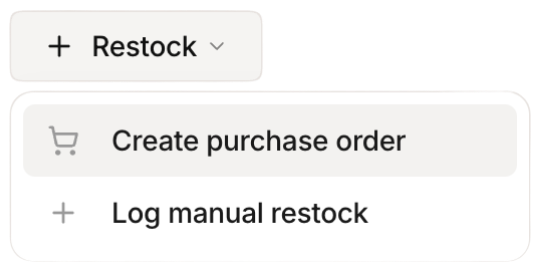 Stockria in action - Restock items with one tap when stock runs low.
Wholesale businesses typically have deeper, more consequential supplier relationships than retailers. A few key practices make the difference.
Track supplier performance. Record on-time delivery rates, order accuracy, and quality issues for every supplier. When it is time to renegotiate terms or choose between suppliers, data beats gut feeling.
Maintain backup suppliers. Single-source dependency is risky. For your critical products, identify at least one alternative supplier. You do not need to order from them regularly - just know they exist and have a relationship established.
Negotiate based on data. When you can show a supplier your order history, growth trajectory, and forecasted demand, negotiations go differently than when you simply ask for a better price. Data gives you leverage.
Align payment terms with your cash cycle. If your customers pay you in 30 days but your supplier wants payment in 15 days, you are financing the gap. Negotiate terms that match your receivables timeline.
Inventory turns and wholesale margins
Wholesale margins are thin - often 15% to 25% gross margin. At these margins, inventory efficiency is the difference between profitability and breaking even.
Focus on inventory turnover. Calculate how many times your inventory turns over per year. Higher turns mean less cash tied up and more profit generated per dollar of inventory. Aim to improve turns by reducing slow movers, tightening reorder quantities, and eliminating dead stock aggressively.
Systems that fit wholesale
Your inventory system needs to handle unit-of-measure conversions (cases to units and back), multiple price tiers per customer, MOQ tracking per supplier, and lot or batch tracking for traceability. Generic retail inventory tools often lack these capabilities. Look for tools that understand wholesale workflows or be prepared to build workarounds.