

What makes B2B inventory different
Selling to other businesses is fundamentally different from selling to consumers. Orders are larger, less frequent, and harder to predict. A single customer might order 500 units one month and nothing for the next three. Lead times from your own suppliers can stretch to weeks or months.
The stakes are higher too. A B2C customer who finds an item out of stock goes to another website. A B2B customer who cannot get what they need on time loses production capacity, misses their own commitments, and starts looking for a new supplier permanently.
Common B2B inventory challenges

Lumpy demand. B2B orders come in bursts. One week you ship 2,000 units, the next week you ship 50. Standard reorder points based on average daily demand do not work well here because the average is misleading.
Long lead times. If your supplier needs 8 weeks to deliver raw materials, you need to forecast demand 8 weeks out. The further you forecast, the less accurate your predictions. This creates a tension between ordering too early (tying up cash) and ordering too late (missing delivery dates).
Custom and configured products. Many B2B sellers offer variations, kitting, or custom configurations. You need to track components and finished goods separately, and you need to know which components are shared across products.
Payment terms and cash flow. Net-30 or Net-60 payment terms mean you buy inventory today but get paid weeks later. Your inventory decisions directly affect your cash position.
Practical tips for B2B inventory
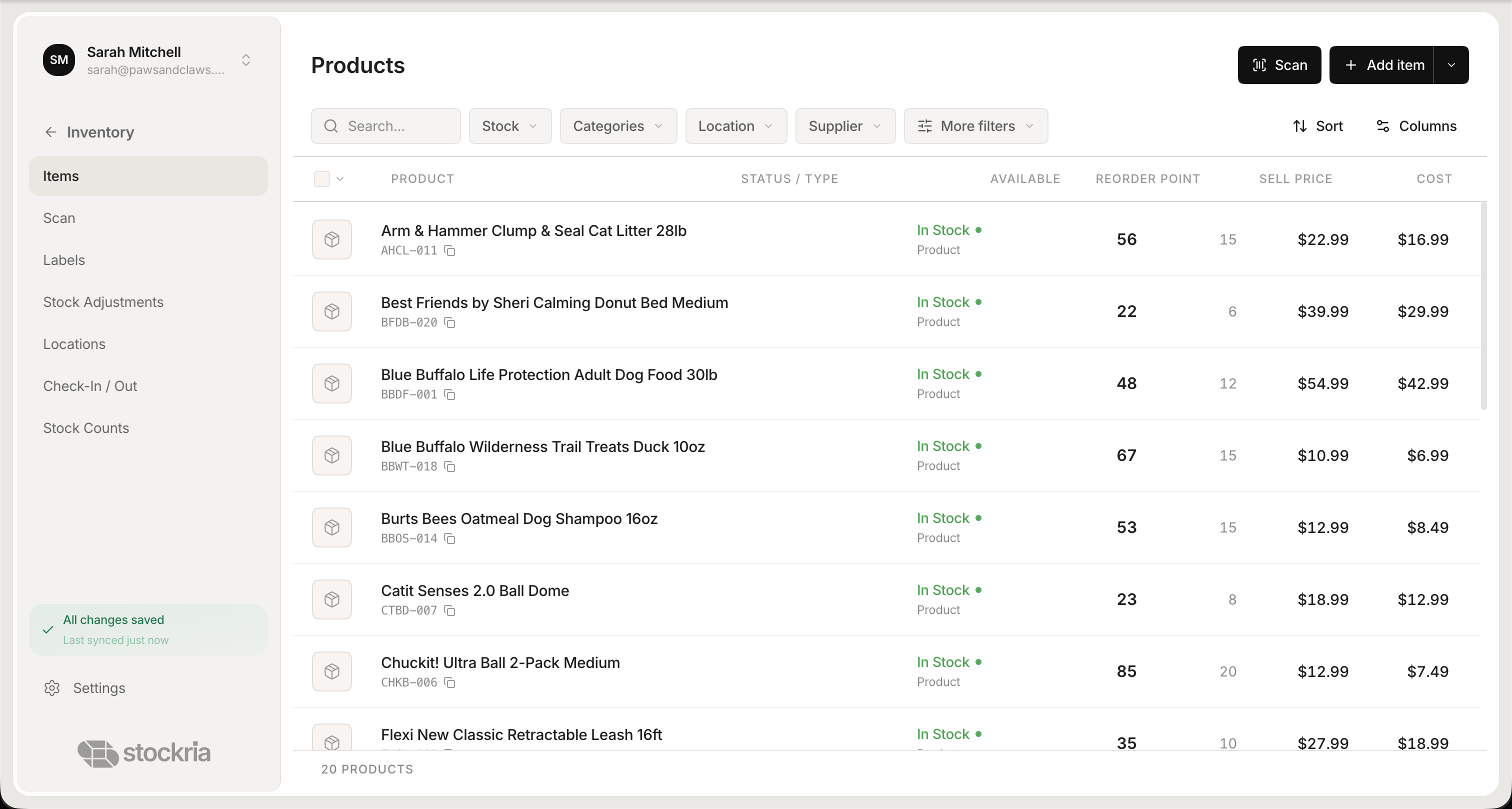 Stockria in action - Real-time stock levels across every location, updated with every scan.
Use customer forecasts, but discount them. Large customers often provide purchase forecasts. These are useful as directional signals but rarely accurate. A common practice is to plan for 70-80% of the forecasted volume and keep buffer stock for the rest.
Segment customers like you segment inventory. Your top 5 customers probably represent more than half your revenue. Track their ordering patterns individually. Set up dedicated safety stock for your biggest accounts.
Build lead time buffers. If your supplier says 6 weeks, plan for 7-8. Track actual lead times over several orders and use the longest recent lead time as your planning number, not the average.
Negotiate blanket purchase orders. Instead of placing individual orders, set up a blanket PO for the quarter with scheduled deliveries. This gives your supplier predictability (often earning you better pricing) and ensures a steady flow of materials.
Forecasting demand in B2B
Pure statistical forecasting struggles with B2B because order volumes are spiky. Combine quantitative data with qualitative input.
Pull the last 12 months of order data by customer. Look for seasonal patterns. Then talk to your sales team. They know which deals are in the pipeline, which customers are growing, and which might be winding down.
A simple approach: take last year's sales by quarter, adjust up or down based on known changes, and add a 15-20% safety buffer. Review monthly and adjust.
Tools that help
Spreadsheets work until you have more than a few dozen SKUs or more than two warehouses. After that, the formulas become fragile and the risk of errors grows.
Stockria tracks stock across locations, monitors supplier lead times, and flags items approaching reorder points. For B2B sellers, the ability to see available-to-promise quantities in real time - accounting for existing commitments - prevents overselling and keeps your largest accounts confident in your reliability.