What a BOM is
A bill of materials is a complete list of everything needed to build one unit of a finished product. It is the recipe for your product - every part, every component, every raw material, along with the quantities required.
Without a BOM, production relies on memory and experience. That works when one person makes everything, but it falls apart as soon as you add employees, scale production, or need to calculate costs accurately.
What goes into a BOM
Each line item in a BOM should include the component name, a part number or SKU, the quantity needed per finished unit, the unit of measure (each, pounds, feet, liters), and the cost per unit.
You can also include supplier information, lead times, and notes about substitutions. Keep it practical - include what helps you build and order, skip what does not.
Single-level BOM
A single-level BOM lists only the immediate components of a product. No sub-assemblies, no drilling down into what those components are made of.
Example - a wooden picture frame:
- 2 long rails (18 inch oak, $1.50 each)
- 2 short rails (12 inch oak, $1.00 each)
- 8 corner screws ($0.05 each)
- 1 glass pane ($3.00)
- 1 backing board ($1.50)
- 1 hanging kit ($0.75)
Total material cost: $8.65 per frame.
Single-level BOMs work for simple products where all components are purchased ready to use. Most small businesses start here.
Multi-level BOM
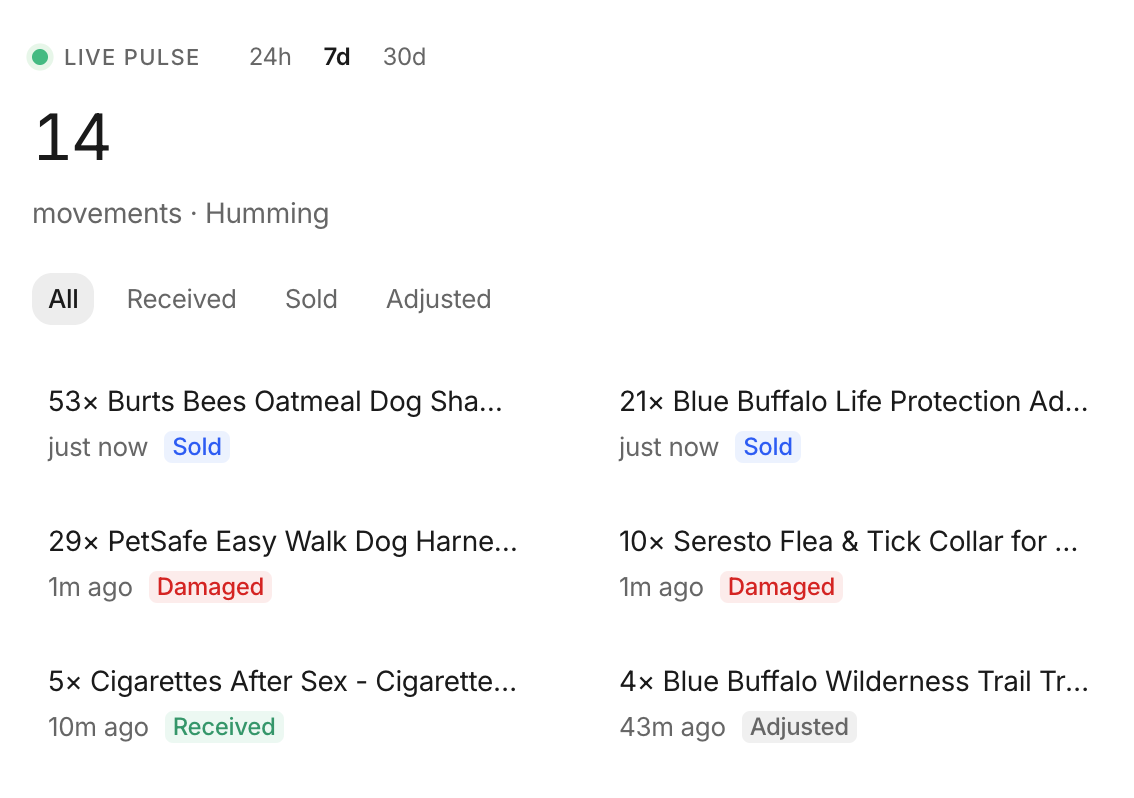 Stockria in action - Low-stock alerts tell you what's running out and when to reorder.
A multi-level BOM breaks down sub-assemblies into their own components. It shows the full hierarchy of what goes into a product.
Example - a table lamp:
Level 0: Table Lamp
- 1 Base Assembly
- 1 Shade Assembly
- 1 Electrical Assembly
- 1 Bulb
Level 1: Base Assembly
- 1 Turned wood base
- 4 Rubber feet
- 1 Weighted insert
Level 1: Electrical Assembly
- 1 Socket
- 6 feet of cord
- 1 Plug
- 1 Switch
You need multi-level BOMs when your products contain sub-assemblies that are built separately. The lamp maker might build base assemblies in batches, stock them, and then assemble complete lamps as orders come in.
Why BOMs matter beyond production
Accurate costing. Without a BOM, you are guessing at your product cost. With one, you know exactly what each unit costs to build. This drives better pricing decisions.
Purchasing. If you need to build 100 picture frames, your BOM tells you to order 200 long rails, 200 short rails, 800 screws, 100 glass panes, 100 backing boards, and 100 hanging kits. No guessing, no shortages.
Inventory planning. BOMs connect finished goods demand to raw material requirements. When you forecast selling 500 lamps next quarter, your BOM converts that into exact component quantities.
Consistency. BOMs ensure every unit is built the same way, regardless of who builds it. This is essential for quality control and training new employees.
Keeping BOMs accurate
BOMs drift over time. You switch to a different screw, change a supplier, or modify the design. When the BOM does not match what you actually build, your cost calculations are wrong and your material planning is off.
Review BOMs quarterly. Whenever you change a component, update the BOM immediately. Assign ownership - one person should be responsible for BOM accuracy.
Start simple
Create a BOM for your top-selling product today. List every component, quantity, and cost. Even this one BOM will improve your understanding of your true product cost and make ordering easier. Expand to more products from there.