

The formula
Total Manufacturing Cost = Direct Materials + Direct Labor + Manufacturing Overhead
Three components. Each one captures a different type of production cost. Miss any one of them and you underestimate what your products actually cost to make, which leads to underpricing and thin margins.
Direct materials

Direct materials are the physical inputs that become part of your finished product. The wood in a table, the fabric in a shirt, the flour in a loaf of bread.
To calculate direct materials cost: take your beginning raw materials inventory, add purchases during the period, and subtract ending raw materials inventory.
Direct Materials Cost = Beginning Inventory + Purchases - Ending Inventory
Example: A candle maker starts the month with $500 in wax and wicks, buys $2,000 more during the month, and has $300 left at the end. Direct materials cost is $500 + $2,000 - $300 = $2,200.
Do not include indirect materials like cleaning supplies, machine lubricant, or packaging tape. Those go into manufacturing overhead.
Direct labor
Direct labor is the wages paid to workers who physically make your products. The person pouring candles, the carpenter building tables, the baker shaping dough.
Include wages, payroll taxes, and benefits for production workers. Do not include supervisors, quality inspectors, or maintenance staff - those are indirect labor and belong in overhead.
Example: The candle maker has two production workers. Worker A earns $3,200 per month and Worker B earns $2,800 per month. Including payroll taxes at 15%, direct labor cost is ($3,200 + $2,800) x 1.15 = $6,900.
Manufacturing overhead
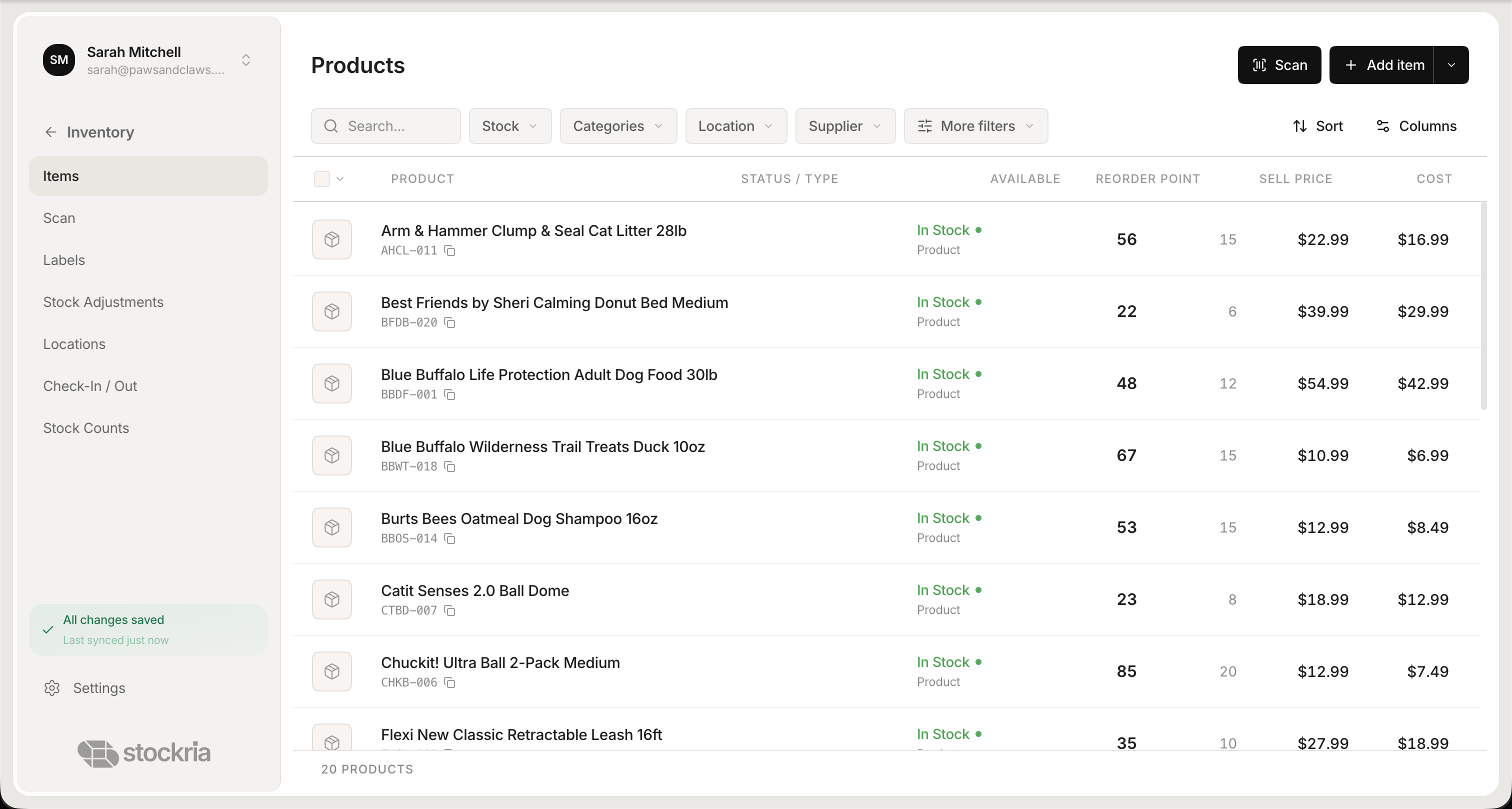 Stockria in action - Real-time stock levels across every location, updated with every scan.
Manufacturing overhead is everything else related to production that is not direct materials or direct labor. This includes factory rent and utilities, equipment depreciation, indirect labor like supervisors and maintenance, indirect materials, quality control costs, and factory insurance.
This is the trickiest component because these costs do not tie directly to individual products. You have to allocate them using a method like direct labor hours, machine hours, or units produced.
Example: The candle maker's monthly overhead is $1,500 for rent, $200 for utilities, $300 for equipment depreciation, and $400 for indirect materials. Total overhead: $2,400.
Putting it all together
For our candle maker:
- Direct materials: $2,200
- Direct labor: $6,900
- Manufacturing overhead: $2,400
- Total manufacturing cost: $11,500
If they produced 2,000 candles that month, the cost per candle is $11,500 / 2,000 = $5.75.
Now the candle maker knows that any candle priced below $5.75 is losing money before you even consider selling expenses, shipping, or administrative costs.
Why TMC matters for pricing
Many small manufacturers price based on materials cost alone. The candle maker might see $1.10 in wax and wick per candle and think a $6 selling price gives them great margin. But the true cost is $5.75, leaving only $0.25 per candle before non-manufacturing expenses.
TMC gives you the real floor for your pricing. Below TMC, you lose money on every unit. Above TMC, you need enough margin to cover selling and administrative costs plus profit.
Track it monthly
Calculate TMC every month. Compare it to the previous month. If costs are rising, find out why. Material price increases? Labor inefficiency? Overhead creeping up? Monthly TMC tracking catches problems before they erode your margins.