

The three stages of manufacturing inventory
Manufacturing inventory is not just "stuff on shelves." It exists in three distinct stages, and you need to track each one differently.
Raw materials are the inputs you buy from suppliers. Lumber, steel, fabric, electronic components - whatever goes into your products before any work is done.
Work-in-progress (WIP) is inventory that is partially completed. A half-assembled chair, a circuit board waiting for soldering, a garment with stitching but no buttons. WIP ties up materials and labor costs but cannot be sold yet.
Finished goods are completed products ready for sale. This is where your inventory becomes revenue.
Why tracking all three matters
Most small manufacturers track finished goods because that is what they sell. Some track raw materials because that is what they buy. Very few track WIP, and that is where problems hide.
If you do not track WIP, you cannot answer basic questions: How much inventory value is on the production floor? Where are the bottlenecks? How long does production actually take?
A furniture maker who tracks only lumber and finished tables has no idea how much value is sitting in half-built tables at any given time. That blind spot makes financial reporting inaccurate and production planning unreliable.
Bills of materials: the foundation
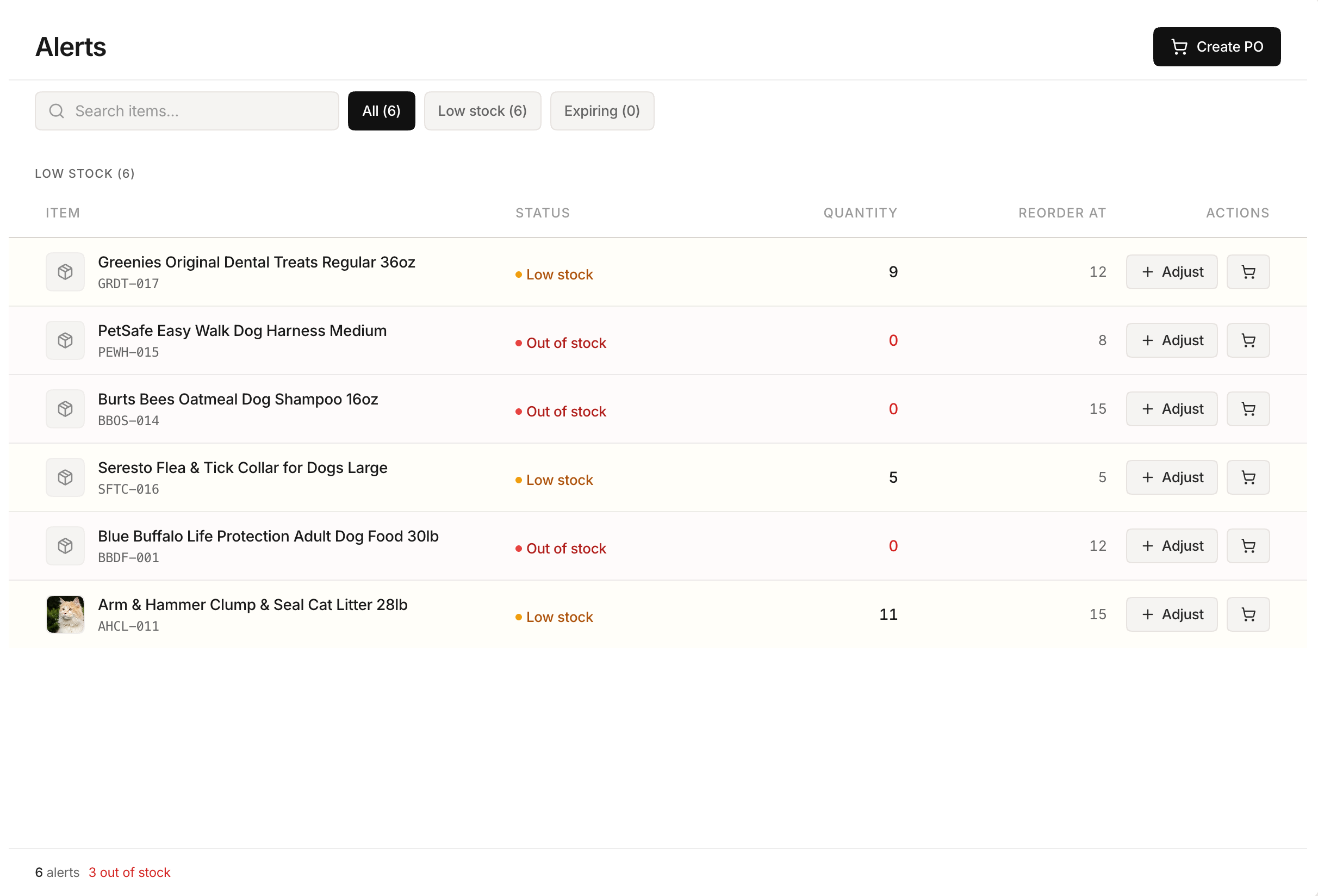 Stockria in action - Full alerts dashboard with days-until-stockout projections.
A bill of materials (BOM) lists every component needed to make one unit of a finished product. It is the recipe for your product.
A simple BOM for a wooden stool might include four legs at $2 each, one seat at $5, twelve screws at $0.10 each, and one can of stain at $3 per unit applied. Total material cost: $17.20 per stool.
Your BOM connects raw materials to finished goods. When you produce 50 stools, your system should automatically deduct the right quantities of each raw material.
Without accurate BOMs, your raw material counts drift. You think you have enough lumber for 100 stools but you actually have enough for 80. That mismatch causes production delays and rush orders.
Practical tips for small manufacturers
Start with your top 10 products. Create accurate BOMs for your best sellers first. Do not try to document everything at once.
Count WIP weekly. Full physical counts of WIP are impractical because items are in various stages of completion. Instead, count how many units are at each production stage once a week.
Set reorder points for raw materials based on production schedules. If you know you produce 200 stools per month and each stool needs four legs, you need 800 legs per month. Set your reorder point to trigger before you drop below two weeks of supply.
Track scrap and waste. Your BOM says 12 screws per stool, but you actually use 13 because one gets dropped or stripped. Adjust your BOMs to reflect reality, not theory.
Moving beyond spreadsheets
Spreadsheets work for tracking raw materials and finished goods separately, but they break down when you need to connect the two through BOMs and production tracking. Once you have more than a handful of products, inventory software that understands manufacturing workflows saves hours of manual reconciliation every week.