

Why inventory costs creep up
Inventory carrying costs typically run 20% to 30% of your inventory value per year. If you hold $100,000 in inventory, you are spending $20,000 to $30,000 annually just to keep it - storage, insurance, shrinkage, obsolescence, and the opportunity cost of tied-up capital.
The good news: you can cut these costs significantly without reducing the stock your customers see on shelves.
1. Identify and liquidate dead stock

Dead stock is inventory that has not sold in 6 to 12 months. Every business has some. It takes up space, ties up cash, and often loses value over time.
Run a report on items with zero or near-zero sales in the past 6 months. Then decide: discount it, bundle it with popular items, return it to the supplier, donate it for a tax deduction, or write it off. Any of these is better than letting it sit.
2. Negotiate better payment terms
Extending payment terms from Net 15 to Net 30 or Net 30 to Net 60 keeps cash in your account longer. That might not seem like a cost reduction, but the interest you earn (or the overdraft fees you avoid) on that float is real money.
Approach your top 5 suppliers and ask. The worst they can say is no.
3. Right-size your reorder quantities
Ordering in bulk to get a volume discount feels like saving money, but the carrying cost of extra inventory often exceeds the discount. If a supplier offers 10% off for buying 1,000 units instead of 500, but the extra 500 units sit for 6 months, the carrying cost eats that discount.
Calculate the true cost of the discount versus the carrying cost. Often, smaller and more frequent orders are cheaper overall.
4. Improve demand forecasting
The better you predict what will sell, the less safety stock you need. Start simple: look at the past 12 months of sales data for each item, identify trends and seasonality, and order based on data rather than instinct.
Even basic forecasting reduces overstock by 10% to 20% for most small businesses.
5. Reduce supplier lead times
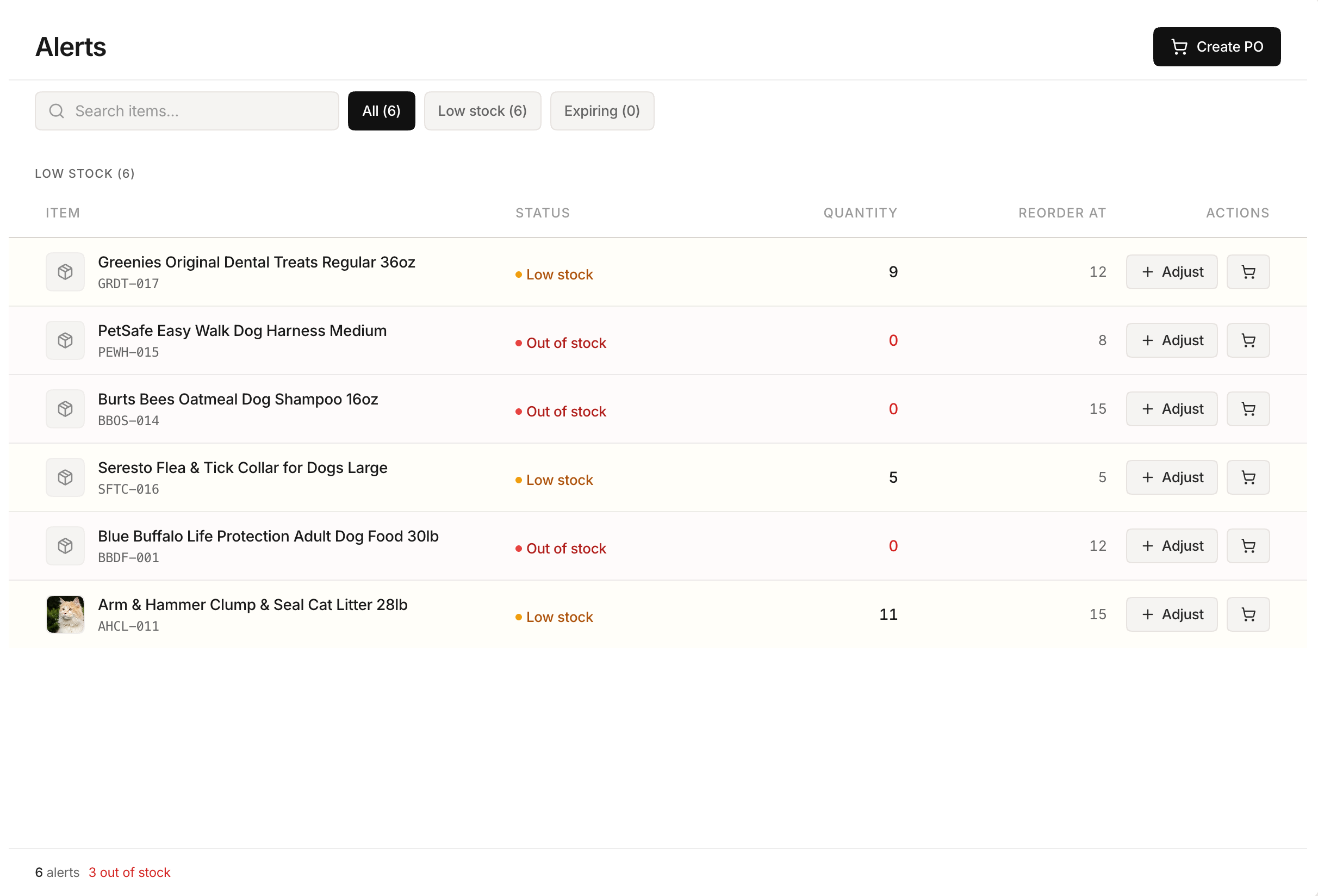 Stockria in action - Full alerts dashboard with days-until-stockout projections.
Shorter lead times mean less safety stock. If your supplier delivers in 3 days instead of 14, you need far less buffer inventory.
Ask suppliers if expedited shipping is available at reasonable cost. Consider switching to closer suppliers for critical items. Sometimes paying slightly more per unit but getting faster delivery lowers your total cost.
6. Implement cycle counting
Annual physical counts are disruptive and expensive. Cycle counting - counting a small portion of inventory each day or week - keeps your numbers accurate without shutting down operations.
Accurate counts mean fewer emergency orders, less overstock from ordering items you already have, and better visibility into shrinkage.
7. Optimize your storage layout
Put fast-moving items near the packing area. Put slow movers in the back or on higher shelves. This does not reduce inventory cost directly, but it reduces labor cost per order, which is part of your total inventory cost.
A simple ABC analysis helps: A items (top 20% by sales volume) get prime locations. B items (next 30%) get secondary spots. C items (bottom 50%) go wherever there is room.
8. Review and renegotiate storage costs
If you rent warehouse space, review your contract annually. Are you using all the space you are paying for? Could you consolidate into a smaller space by reducing dead stock and optimizing layout?
If you use a 3PL (third-party logistics), compare rates regularly. The market is competitive, and your current provider may not have the best rates for your current volume.
Start with the biggest win
You do not need to do all eight at once. Start with dead stock identification - it is the fastest win and requires no negotiation or process change. Then work down the list based on which items represent the largest cost for your specific business.