

What MRP does in plain language
MRP answers three questions: What materials do I need? How many do I need? When do I need them?
It takes your production schedule, looks at what each product requires to build, checks what you already have in stock, and tells you exactly what to order and when. No guessing, no last-minute scrambles for parts.
Before MRP, manufacturers ordered materials based on gut feeling or reordered when they noticed shelves getting empty. MRP replaced gut feeling with math.
The three inputs MRP needs

1. Master production schedule (MPS). This is your plan for what you are going to make and when. "We need 200 widgets by March 15 and 300 by April 1." Without a production schedule, MRP has nothing to plan against.
2. Bill of materials (BOM). The recipe for each product. A widget needs 3 bolts, 1 housing, and 2 circuit boards. The BOM tells MRP what raw materials are needed for each finished product.
3. Inventory status records. What you currently have on hand, what is already on order, and when those orders are expected to arrive. MRP subtracts what you have from what you need to determine what to buy.
What MRP gives you
From those three inputs, MRP produces planned purchase orders showing what to buy, how much, and when to place the order. It produces work orders showing when to start production on each item to meet your delivery dates. And it flags exceptions where something does not add up - a lead time too long to meet a deadline, a supplier who cannot deliver in time, or insufficient capacity.
The real value is in the timing. MRP does not just tell you to buy 600 bolts. It tells you to order them by February 28 because your supplier needs 10 business days and production starts March 14.
Do you need MRP?
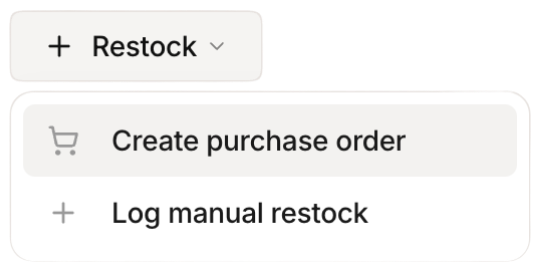 Stockria in action - Restock items with one tap when stock runs low.
You probably need MRP if your products have more than five components, you produce multiple products that share components, lead times from suppliers vary, and you regularly run into material shortages or order too much.
You probably do not need MRP if you make one or two simple products, your BOMs have fewer than five items, you order the same materials in the same quantities every month, or your production volume is low enough to manage mentally.
MRP without enterprise software
You do not need a $50,000 ERP system to do basic MRP. The logic is straightforward enough to run in a spreadsheet for simple operations.
List your production schedule for the next 8 to 12 weeks. Multiply by your BOMs to get gross material requirements. Subtract current inventory and outstanding purchase orders. The result is your net requirements - what you actually need to buy.
The spreadsheet approach breaks down when you have dozens of products, shared components, and varying lead times. At that point, dedicated MRP software saves you from errors that spreadsheets make easy to miss.
Start with the basics
Get your BOMs accurate first. MRP is only as good as the data you feed it. If your BOM says a product needs 10 screws but it actually needs 12, every plan MRP produces will be short on screws. Spend time on data quality before you spend money on software.