

Why warehouse organization directly affects your bottom line
A disorganized warehouse costs you money every day. Employees waste time searching for products. Orders ship late because items are hard to find. Inventory counts are inaccurate because stock is scattered across random locations. For small businesses, where every hour of labor matters, a well-organized storage area pays for itself almost immediately.
You do not need a massive facility or expensive equipment to get organized. Even a single storage room or garage can benefit from these principles.
Plan your layout around product movement

Before you move anything, answer one question: which products move the fastest? Your layout should be built around this answer.
High-velocity items belong closest to your packing and shipping area. If 20 percent of your products account for 80 percent of your orders, those items should be within arm's reach of where orders get assembled.
Medium-velocity items go in the middle of your space. They need to be accessible but do not require prime real estate.
Slow-moving items can go in the back, on higher shelves, or in less convenient spots. You access them infrequently, so distance is not a problem.
Map out your space on paper first. Sketch where receiving, storage, packing, and shipping happen. Products should flow in one direction through these zones without backtracking.
Set up zone-based organization
Divide your storage area into clearly defined zones. Each zone gets a letter or number, and every shelf, bin, or pallet position within that zone gets a unique address.
A simple addressing system looks like this: Zone A, Shelf 3, Bin 2 = A-3-2. Anyone on your team can find the item without asking for directions.
Common zones include:
- Receiving zone: Where incoming shipments are checked and unpacked.
- Bulk storage: Where full cases or pallets are kept.
- Pick zone: Where individual items are stored for order fulfillment.
- Packing and shipping: Where orders are assembled and labeled.
- Returns area: A dedicated spot for processing returned items.
Keep zones physically separated, even if that just means a strip of tape on the floor. Mixing zones creates confusion.
Label everything clearly
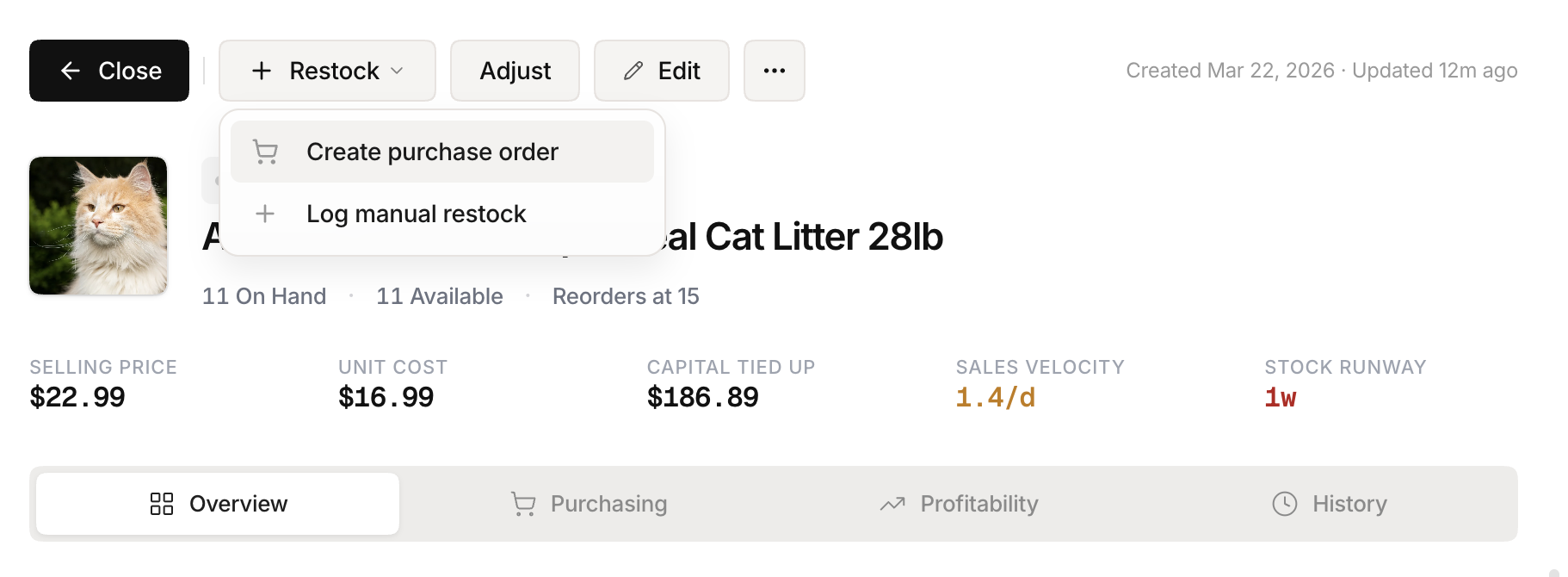 Stockria in action - Reorder point tracking keeps your supply chain on schedule.
Labels are the cheapest improvement you can make. Every shelf, bin, rack, and floor position should have a visible label showing its address code. Use large, high-contrast text that can be read from a few feet away.
For products, include the SKU, product name, and bin location on each label. If you are not ready for barcodes, printed labels work fine. Handwritten labels are better than no labels.
Replace damaged or faded labels immediately. A label you cannot read is the same as no label.
Design efficient pick paths
A pick path is the route an employee follows to gather items for an order. The goal is to minimize walking distance and avoid backtracking.
For small operations, a simple S-pattern works well: walk down one aisle, turn, and walk back up the next. Place your most-ordered items along the shortest path.
If you process multiple orders at once, batch similar orders together. Picking five orders that all need items from Zone A at the same time is much faster than walking to Zone A five separate times.
Maintain it with weekly habits
Organization is not a one-time project. Build these habits into your weekly routine:
- Return misplaced items to their correct locations every day.
- Review your product velocity monthly and reslot items that have changed.
- Keep aisles and workspaces clear of clutter and empty boxes.
- Audit one zone per week so you cycle through the entire warehouse regularly.
A warehouse that stays organized runs faster, ships more accurately, and makes inventory counts straightforward.