
What counts as manufacturing overhead
Manufacturing overhead includes every production cost that is not direct materials or direct labor. These are the costs you cannot easily trace to a specific product.
Common examples: factory rent, utilities for the production area, equipment depreciation, maintenance and repairs, quality control staff, factory insurance, and indirect materials like lubricants or cleaning supplies.
Your salary as the owner is not manufacturing overhead unless you work directly on production. Office rent for administrative staff is not manufacturing overhead either - that is a period expense.
The basic formula

Manufacturing Overhead Rate = Total Manufacturing Overhead Costs ÷ Allocation Base
The allocation base is the activity measure you use to spread overhead across products. Common allocation bases include direct labor hours, machine hours, direct labor cost, and units produced.
For example, if your total monthly overhead is $10,000 and your workers log 2,000 direct labor hours, your overhead rate is $5 per direct labor hour. A product that takes 3 hours of labor gets $15 of overhead allocated to it.
Choosing an allocation method
Direct labor hours. Best when production is labor-intensive and different products require significantly different amounts of labor. A custom cabinet shop where some pieces take 5 hours and others take 50 hours would use this method.
Machine hours. Best when production is machine-intensive. A CNC shop or printing company where the machines do most of the work should allocate overhead based on machine time.
Direct labor cost. Useful when you have workers at different pay rates. Higher-paid skilled workers often use more expensive equipment and resources, so tying overhead to labor cost can be more accurate than labor hours.
Units produced. The simplest method but only accurate when all your products are similar. If you make one product or very similar products, this works fine. If you make both simple and complex products, this method will over-allocate to simple products and under-allocate to complex ones.
A worked example
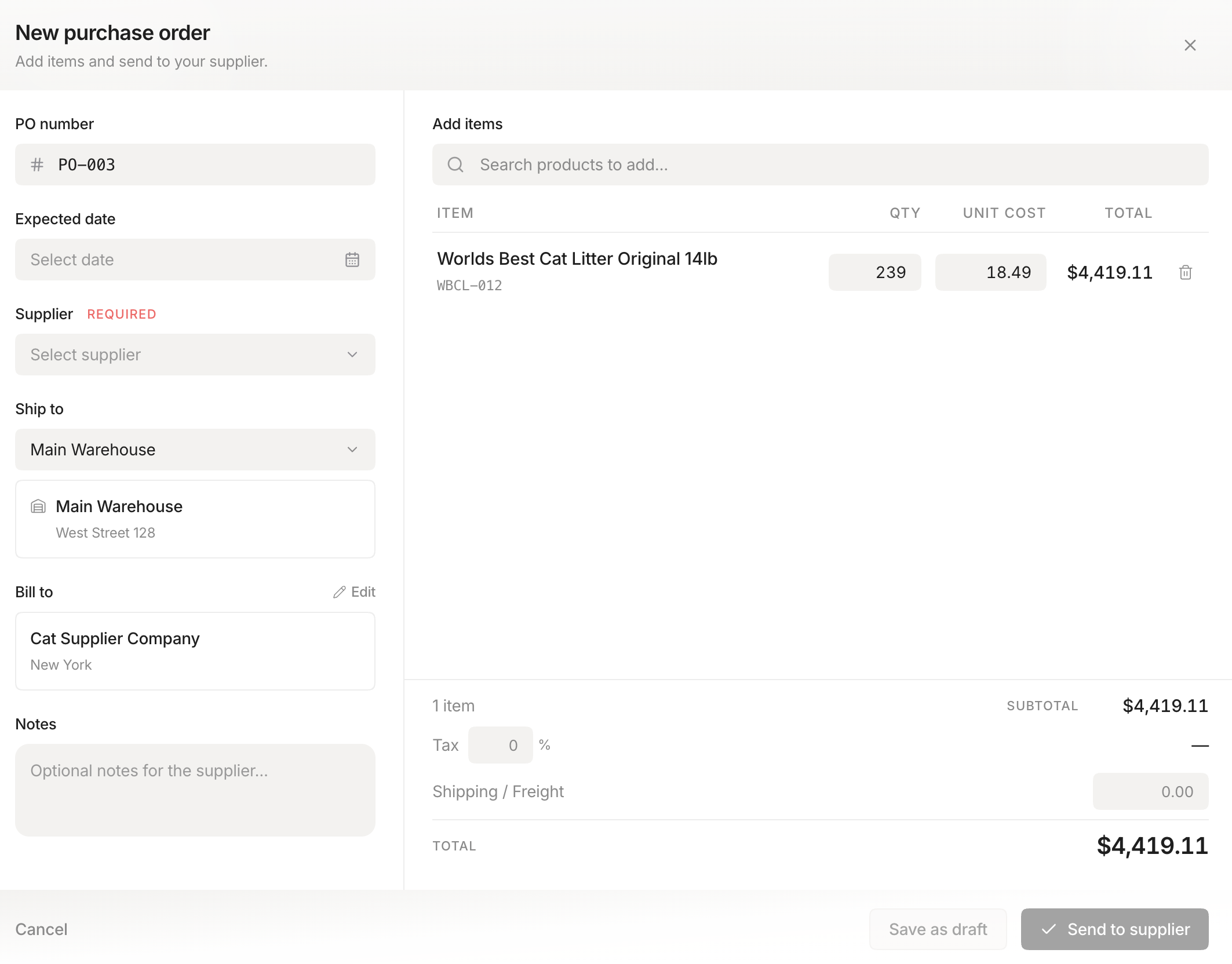 Stockria in action - Create and send purchase orders to your suppliers in seconds.
Say you run a small woodworking shop. Your monthly overhead costs break down to $2,000 for rent, $400 for utilities, $800 for equipment depreciation, $300 for insurance, and $500 for indirect materials. Total: $4,000 per month.
Your shop logs 500 machine hours per month. Your overhead rate is $4,000 ÷ 500 = $8 per machine hour.
A dining table that uses 10 machine hours gets $80 of overhead. A cutting board that uses 0.5 machine hours gets $4. This feels right - the table uses more shop resources.
If you used units produced instead, and you made 100 items that month, each item would get $40 of overhead. The cutting board would be dramatically over-costed and the table under-costed.
Why this matters for pricing
If you do not allocate overhead to products, you do not know your true production cost. You might price a product at $50 thinking it costs $30 to make, when the actual cost including overhead is $45. Your real margin is $5, not $20.
Keep it simple but keep it accurate
Recalculate your overhead rate quarterly. Costs change and production volumes shift. An outdated overhead rate gives you outdated product costs, which leads to pricing mistakes. Pick the allocation method that best reflects how your products actually consume resources, and review it as your business evolves.