

What is cost of goods manufactured?
Cost of goods manufactured (COGM) is the total cost of producing finished goods during a specific period. It tells you how much it cost to make the products that moved from your production floor to your finished goods inventory.
COGM is essential for any business that makes its own products - whether you are a bakery, a furniture maker, or a small manufacturer. Without knowing your COGM, you cannot accurately price your products, calculate profit margins, or file accurate financial statements.
COGM is different from cost of goods sold (COGS). COGM measures the cost of production. COGS measures the cost of what was actually sold to customers. If you make 100 units but only sell 80, COGM covers all 100 and COGS covers the 80.
The COGM formula

COGM = Direct Materials Used + Direct Labor + Manufacturing Overhead + Beginning WIP Inventory - Ending WIP Inventory
Let's break down each component.
Direct materials used - The raw materials that physically become part of the finished product. For a furniture maker, this is wood, screws, stain, and fabric. Calculate it as: beginning raw materials inventory + raw materials purchased - ending raw materials inventory.
Direct labor - Wages paid to workers who directly work on producing the product. This includes the carpenter building the table, not the office manager processing payroll.
Manufacturing overhead - All other production costs that are not direct materials or direct labor. This includes factory rent, equipment depreciation, utilities for the production area, indirect materials (sandpaper, glue), and indirect labor (supervisors, maintenance staff).
Work-in-progress (WIP) inventory - Products that are started but not finished. Beginning WIP is what was partially complete at the start of the period. Ending WIP is what remains partially complete at the end.
Step-by-step example
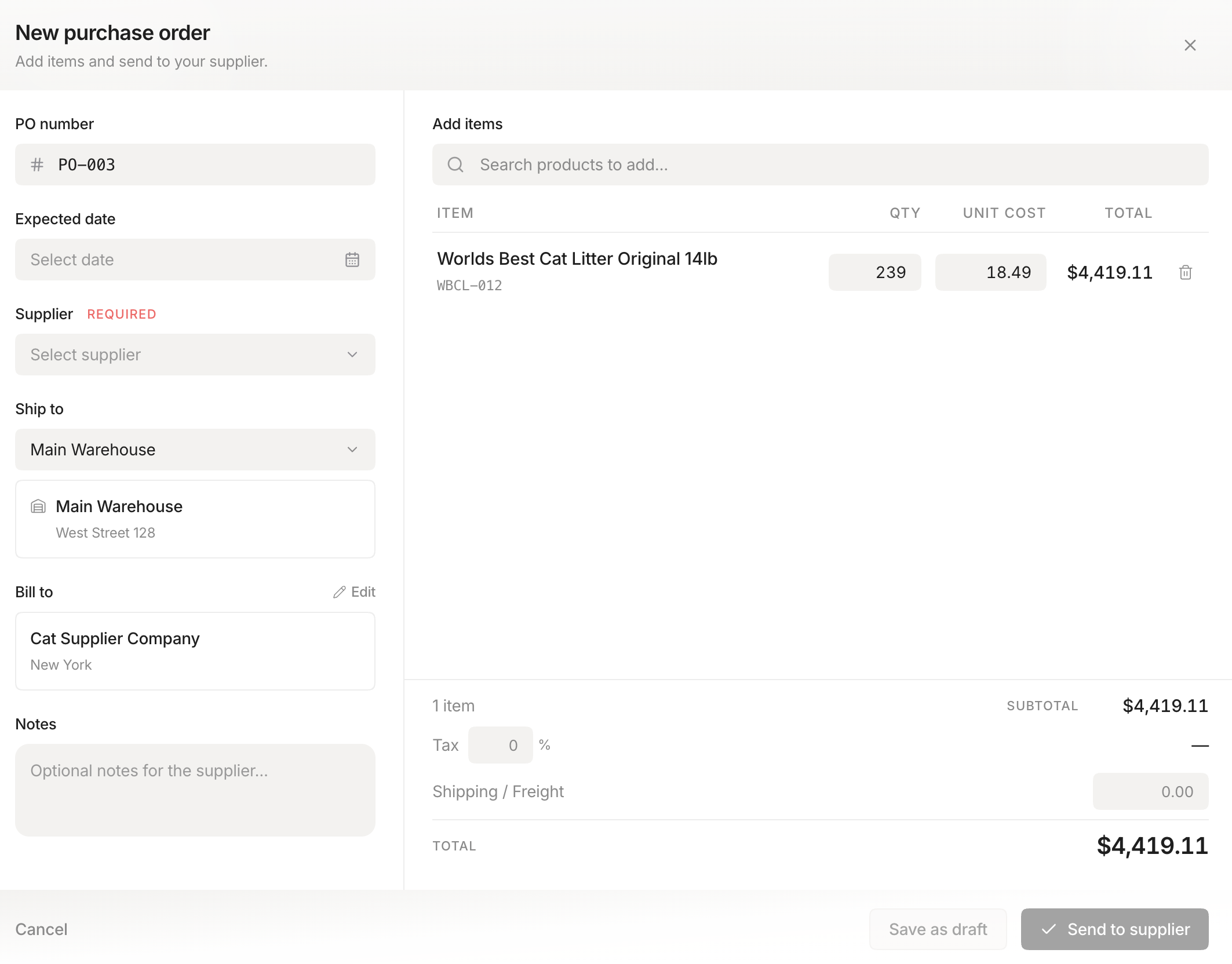 Stockria in action - Create and send purchase orders to your suppliers in seconds.
A small candle company wants to calculate COGM for January.
Step 1: Calculate direct materials used. Beginning raw materials: $3,000 (wax, wicks, fragrance oils, jars on hand January 1). Materials purchased in January: $5,000. Ending raw materials: $2,200. Direct materials used = $3,000 + $5,000 - $2,200 = $5,800.
Step 2: Add direct labor. Two production employees worked a combined 320 hours at $18/hour. Direct labor = 320 x $18 = $5,760.
Step 3: Add manufacturing overhead. Workshop rent: $1,200. Equipment depreciation: $300. Utilities: $400. Supplies (labels, packaging material): $340. Total overhead = $2,240.
Step 4: Account for WIP inventory. Beginning WIP (candles poured but not cured/labeled on January 1): $800. Ending WIP (candles in progress on January 31): $1,100.
Step 5: Calculate COGM. COGM = $5,800 + $5,760 + $2,240 + $800 - $1,100 = $13,500.
The company spent $13,500 to produce finished candles in January.
Why COGM matters for pricing
If the candle company produced 1,500 finished candles in January, the average production cost per candle is $13,500 / 1,500 = $9.00. If they sell candles for $22 each, their gross margin per candle is $13.00 (59%).
Without COGM, you are guessing at your costs. And guessing leads to either underpricing (eroding profit) or overpricing (losing customers).
Common mistakes to avoid
Forgetting overhead. Many small manufacturers calculate materials and labor but skip overhead. That workshop rent is a real production cost even if it does not feel like it.
Ignoring WIP. If you skip the WIP adjustment, your COGM will be wrong whenever you have partially finished products at the start or end of the period.
Mixing production and selling costs. COGM only includes production costs. Shipping to customers, marketing, and sales commissions are selling expenses, not manufacturing costs.
Track your materials, labor hours, and overhead monthly. Over time you will spot trends - rising material costs, improving labor efficiency, or overhead creeping up. That visibility is how you stay profitable as costs change.