

Why inventory accounting matters for your business
Inventory is not just what sits on your shelves. It is an asset on your balance sheet and a major factor in your tax calculations. How you account for inventory affects your reported profits, your tax bill, and your ability to make smart purchasing decisions.
You do not need to become an accountant, but understanding the basics helps you choose the right system, communicate with your bookkeeper, and catch mistakes before they become expensive.
Perpetual vs periodic: two approaches to tracking costs

There are two main systems for inventory accounting, and they differ in how often they update your records.
Perpetual inventory updates your inventory account with every transaction. When you buy stock, the system records the increase. When you sell an item, it immediately records the decrease and calculates the cost of goods sold. Your records reflect reality in real time.
This system works well when you use inventory software that connects to your point of sale. It gives you up-to-date numbers at any moment, which is valuable for making purchasing decisions and monitoring profitability by product.
Periodic inventory only updates your inventory account at set intervals, usually monthly or quarterly. Between updates, purchases go into a temporary account. At the end of the period, you do a physical count, calculate the value of what is on hand, and derive your cost of goods sold from the difference.
This approach is simpler to maintain manually and costs less to set up. It works for businesses with lower transaction volumes or those not yet using inventory software.
How basic journal entries work
Even if your bookkeeper handles the entries, knowing the basics helps you understand your financial statements.
When you purchase inventory (perpetual): Your inventory asset account increases, and your cash or accounts payable decreases by the same amount. If you buy 100 units at $5 each, inventory goes up by $500.
When you sell inventory (perpetual): Two things happen. First, you record the revenue from the sale. Second, you move the cost of those items from your inventory account to your cost of goods sold account. This directly reduces your gross profit.
Under the periodic system: Purchases go into a separate "Purchases" account throughout the period. At period end, you calculate cost of goods sold using this formula: Beginning Inventory + Purchases - Ending Inventory = Cost of Goods Sold.
Choosing a valuation method
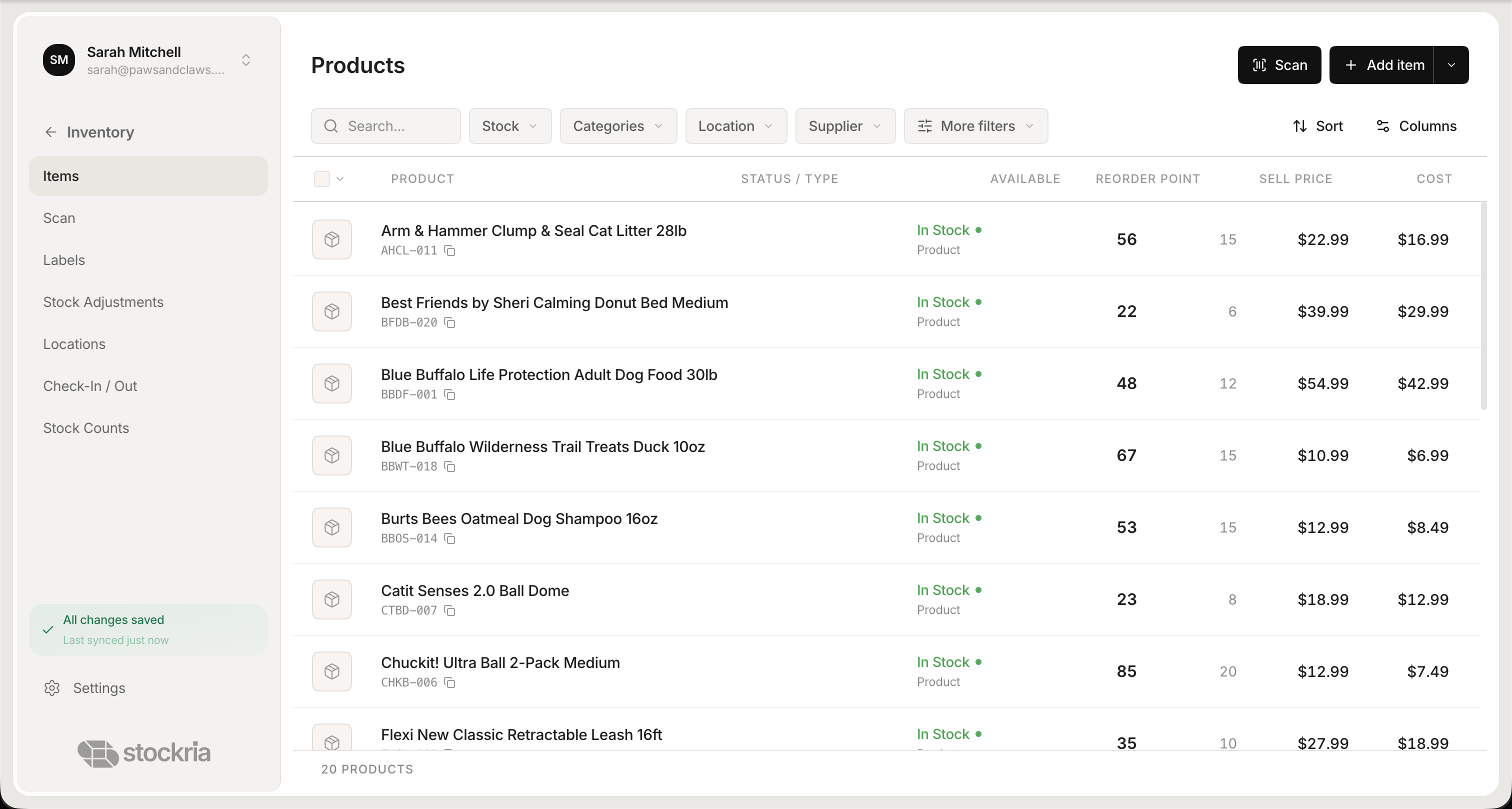 Stockria in action - Real-time stock levels across every location, updated with every scan.
When you buy the same product at different prices over time, you need a rule for which cost to use when you sell a unit. The three common methods are:
- FIFO (First In, First Out): Assumes the oldest inventory sells first. During rising prices, this results in lower cost of goods sold and higher reported profit.
- LIFO (Last In, First Out): Assumes the newest inventory sells first. This can reduce taxable income when prices rise, but is not allowed under international accounting standards.
- Weighted average: Calculates an average cost across all units. Simple and smooth, avoiding the extremes of FIFO and LIFO.
For most small businesses, FIFO is the most intuitive choice and matches how you likely already rotate your physical stock.
Common mistakes to avoid
Ignoring shrinkage. If your records say 100 units but you only have 95 on the shelf, those 5 missing units have accounting implications. Record adjustments when they happen.
Mixing personal and business inventory. Keep business inventory accounts separate from any personal purchases, even if you operate from home.
Not reconciling regularly. Your physical count should match your accounting records. When it does not, investigate and adjust. Waiting until year-end to reconcile creates a mess.
Getting started with the right system
If you sell fewer than 50 items and handle bookkeeping yourself, the periodic method keeps things manageable. If you use point-of-sale software or sell online, a perpetual system is worth the setup effort because it gives you the real-time data you need to make better decisions.