

Why inventory valuation matters
The method you use to value inventory directly affects your cost of goods sold, your taxes, and your profit margins. Two businesses with identical sales can report different profits simply because they chose different valuation methods.
Pick the wrong method and you might overpay taxes in a good year or misunderstand your actual margins. Pick the right one and your financial statements reflect reality.
FIFO: first in, first out

FIFO assumes the oldest inventory is sold first. If you bought 100 units at $5 in January and 100 units at $7 in March, FIFO says the next sale uses the $5 cost.
Best for: Perishable goods, fashion, electronics, or anything where you actually move older stock first. Most small retailers use FIFO because it matches how they physically handle inventory.
Tax impact: When prices rise, FIFO reports higher profits because you are matching older, lower costs against current revenue. That means higher taxes but a stronger-looking balance sheet.
LIFO: last in, first out
LIFO assumes the newest inventory is sold first. Using the same example, LIFO says the next sale uses the $7 cost.
Best for: Commodities and raw materials where prices fluctuate. LIFO can lower your tax bill during inflationary periods because it matches higher recent costs against revenue.
Important note: LIFO is allowed under US GAAP but not under IFRS. If you sell internationally or may seek foreign investment, LIFO could complicate your accounting. Also, LIFO rarely matches how you actually move physical inventory.
Weighted average cost
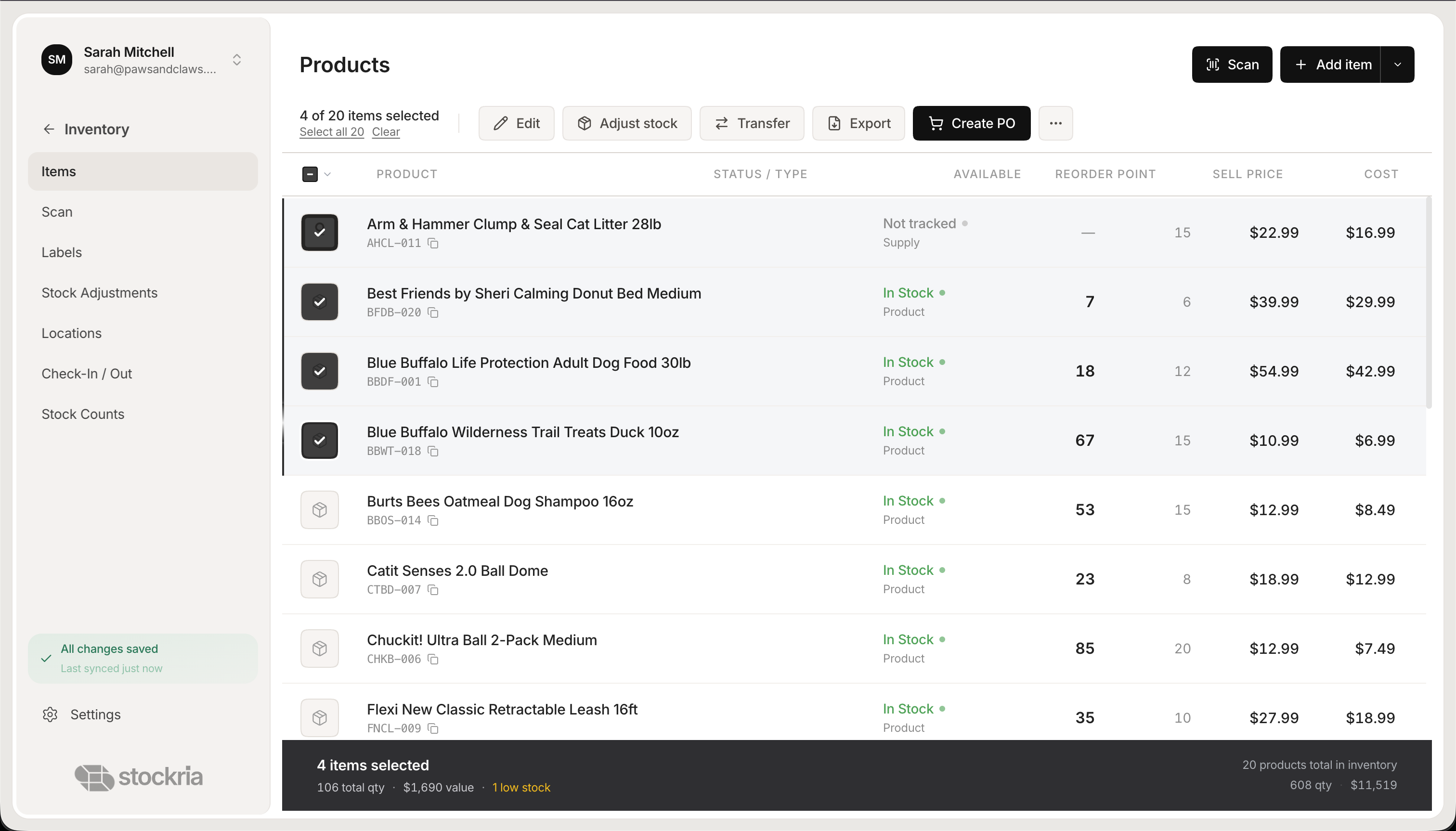 Stockria in action - Manage your entire product catalog with stock levels, pricing, and reorder points.
This method calculates the average cost of all units available for sale. If you have 100 units at $5 and 100 units at $7, your weighted average cost is $6 per unit.
Best for: Businesses with large volumes of similar items where tracking individual costs is impractical. Think hardware stores, bulk suppliers, or anyone dealing in commodities. It smooths out price fluctuations and keeps bookkeeping simple.
Calculation: Total cost of goods available ÷ total units available = weighted average cost per unit. Recalculate after each purchase.
Specific identification
This method tracks the exact cost of each individual item. You know precisely which unit you sold and what you paid for it.
Best for: High-value, low-volume items. Jewelry stores, car dealerships, art galleries, custom furniture makers. If each item is unique or expensive enough to track individually, this method gives the most accurate picture.
Downside: It requires meticulous tracking. For a business selling hundreds of similar items daily, specific identification creates more work than it is worth.
How to choose
Ask yourself three questions:
- Do you sell perishable or time-sensitive goods? Use FIFO.
- Do you sell high-value, unique items? Use specific identification.
- Do you sell large volumes of similar items? Weighted average is your friend.
- Are you focused on minimizing taxes during inflation? LIFO may help, but consult your accountant.
Once you pick a method, stay consistent. Switching methods requires IRS approval and creates accounting headaches. Get it right from the start.
Most inventory software defaults to FIFO, and for good reason - it works for the majority of small businesses. Unless you have a specific reason to choose something else, FIFO is a solid starting point.
The bottom line
Do not overthink this decision, but do make it deliberately. Talk to your accountant before your first tax filing. The right valuation method saves you money and keeps your books accurate. The wrong one creates problems that compound over time.