

What is ABC inventory analysis?

ABC analysis is a way to sort your inventory into three groups based on how much revenue each item generates. The idea comes from the Pareto principle: roughly 20% of your products drive 80% of your revenue.
- A items - Your top 10-20% of products by annual revenue. These are your most valuable items. They deserve the most attention, tighter reorder points, and more frequent counts.
- B items - The middle 20-30%. Important but not critical. They need regular monitoring but not daily oversight.
- C items - The remaining 50-70% of products. Each one contributes little revenue individually. Manage them with simpler rules and less frequent review.
How to classify your inventory

Start with a spreadsheet or your inventory software. You need two numbers for each product: the unit cost and the number of units sold over the past 12 months.
- Multiply unit cost by annual units sold to get annual consumption value for each item
- Sort the list from highest to lowest
- Calculate each item's percentage of total consumption value
- Add a running cumulative percentage column
- Items in the top 70-80% of cumulative value are A items. The next 15-20% are B items. Everything else is C.
For example, a coffee shop with 200 SKUs might find that their 25 most popular beans and syrups account for 75% of revenue. Those are A items. The next 50 items make up 20%. The remaining 125 items - novelty mugs, seasonal flavors, branded merch - are C items.
Setting rules for each category
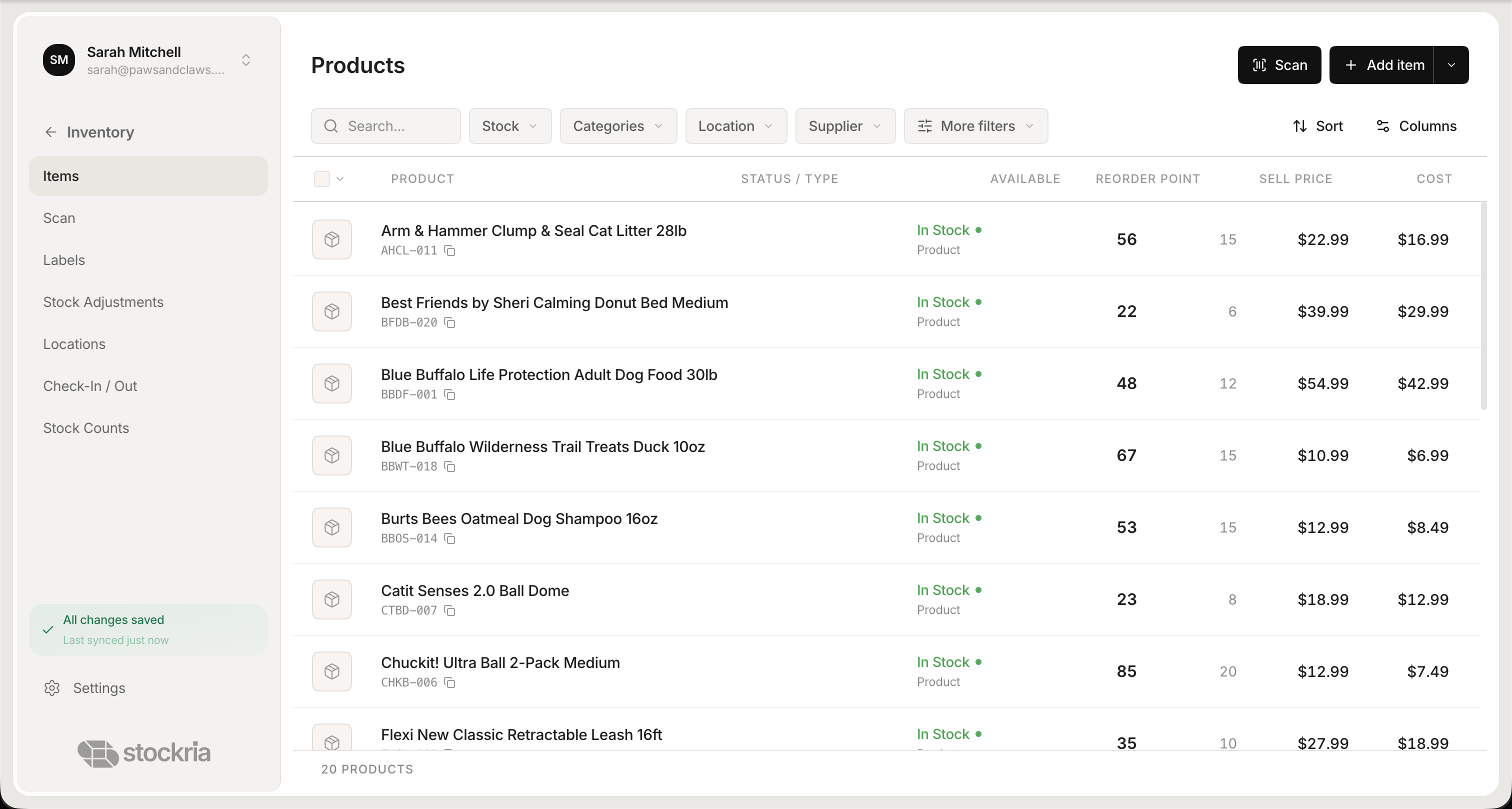 Stockria in action - Real-time stock levels across every location, updated with every scan.
**
Stockria in action - Real-time stock levels across every location, updated with every scan.
**
Once you have your categories, assign different management rules to each.
A items: Review weekly. Set safety stock levels with a buffer. Count these in every cycle count. Negotiate better terms with suppliers since volume justifies it. Track lead times closely.
B items: Review biweekly or monthly. Maintain moderate safety stock. Include in cycle counts quarterly. Standard reorder points work fine here.
C items: Review monthly or quarterly. Keep minimal safety stock or order on demand. Count twice a year. Consider dropping items that have not sold in 90 days.
When ABC analysis breaks down
ABC analysis works well for stable businesses with predictable demand. It struggles in a few situations.
New products have no sales history. You cannot classify them accurately until you have 3-6 months of data. Start them as B items and reclassify later.
Seasonal items might be A items in December and C items in July. Run the analysis for peak and off-peak periods separately, or use a rolling 12-month window.
Critical but low-value items can cause problems. A $2 gasket might be a C item by revenue, but if running out stops your production line, it deserves A-level attention. Some businesses add a D category for these critical-but-cheap items.
Putting it into practice
Reclassify your inventory every quarter. Customer preferences shift, new products launch, and old ones fade. An item that was A-level last year might be B-level now.
The real payoff is in time savings. Instead of treating all 500 products equally, you focus your energy on the 50 that actually move the needle. You spend less time managing slow movers and more time making sure your bestsellers never run out.
Most inventory tools, including Stockria, let you tag items by category and set different reorder rules for each group. Start by exporting your sales data, running the analysis, and tagging your items. The whole process takes about an hour for a small catalog.