

The core difference
Markup is how much you add to your cost to get your selling price. It is based on cost.
Margin is how much of your selling price is profit. It is based on revenue.
Same product, same numbers, different perspective. That difference trips up a lot of business owners.
The formulas

Markup = (Selling Price - Cost) ÷ Cost × 100
Margin = (Selling Price - Cost) ÷ Selling Price × 100
Example: You buy a product for $60 and sell it for $100.
Markup: ($100 - $60) ÷ $60 × 100 = 66.7%
Margin: ($100 - $60) ÷ $100 × 100 = 40%
Same product, same profit of $40, but the percentages look very different. A 66.7% markup gives you a 40% margin.
The mistake that costs real money
A store owner tells their team to price everything at 50% margin. The team interprets that as 50% markup. On a $20 item, 50% markup gives a $30 selling price. But 50% margin means the selling price should be $40.
That single misunderstanding cuts the profit per item from $20 to $10. Across thousands of transactions, the losses add up fast.
This happens more often than you might think, especially when different people in the business use the terms interchangeably.
Quick reference table
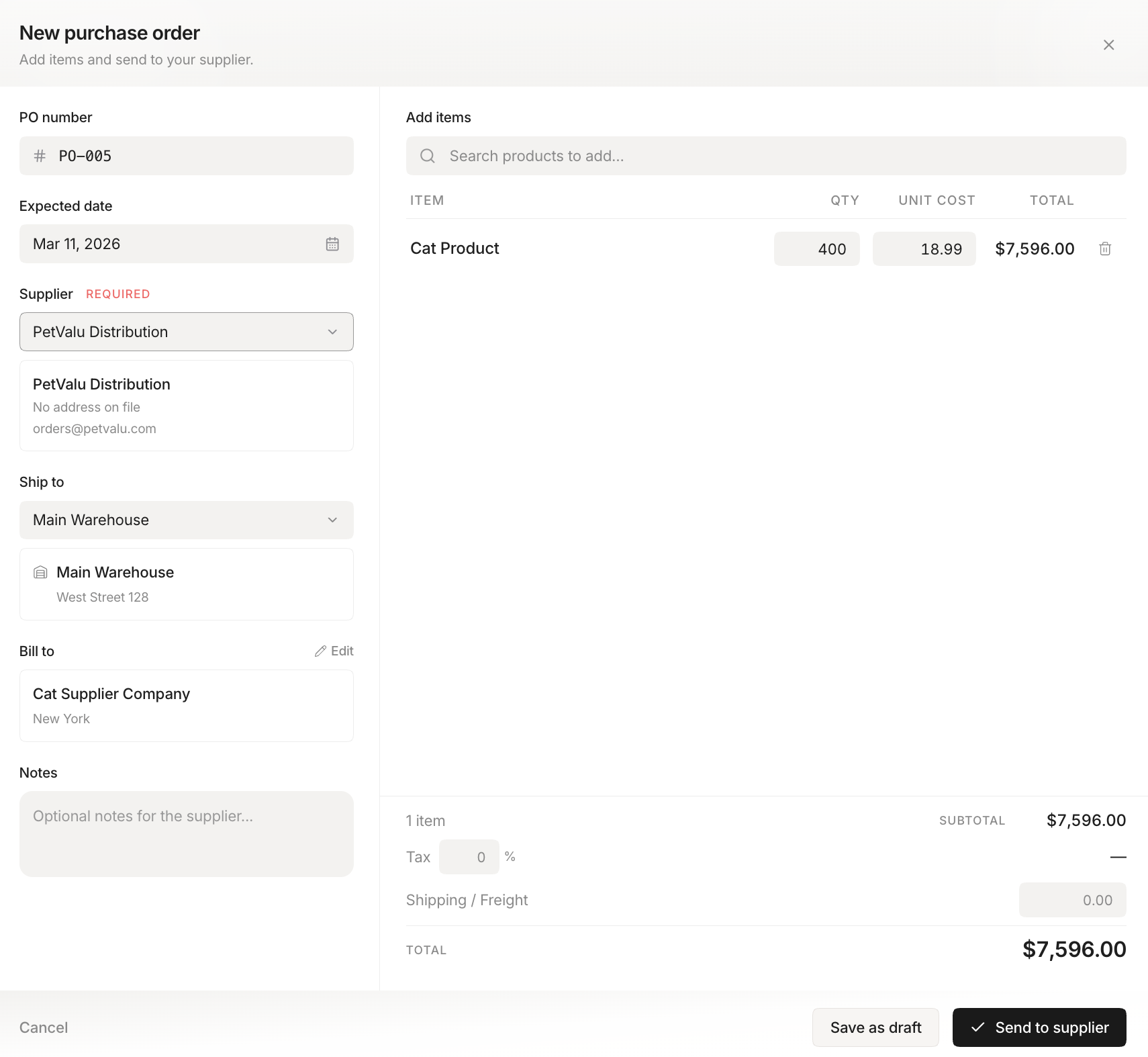 Stockria in action - Generate purchase orders from your low-stock list.
Here are common markup percentages and their margin equivalents.
A 25% markup gives you a 20% margin. A 50% markup gives you a 33.3% margin. A 100% markup gives you a 50% margin. A 200% markup gives you a 66.7% margin.
Notice the pattern: markup percentages are always higher than the corresponding margin percentages. If someone quotes you a "margin" that seems high, they might actually be talking about markup.
Which one should you use?
Use margin when talking about financial performance. Your income statement, your bank, and your investors think in terms of margin. A 40% gross margin is a meaningful financial metric.
Use markup when setting prices. Markup is more intuitive when you are looking at a cost and deciding what to charge. "I need a 100% markup on this" is easier to calculate in your head than "I need a 50% margin on this," even though they produce the same price.
Use the same term consistently within your team. Pick one and make sure everyone uses it the same way. If your pricing guidelines say "50% markup," make sure nobody interprets that as margin.
Common industry markups
Grocery stores typically work on 25-50% markup. Clothing retail runs 100-300% markup depending on the brand and channel. Restaurants mark up food 200-400%. These are rough ranges that vary widely, but they give you a benchmark.
If your margins seem thin compared to your industry, check whether you are accidentally comparing your margin to someone else's markup.
The takeaway
Know the difference, pick the right term for the right context, and make sure everyone on your team speaks the same language. A five-minute conversation about margin versus markup can prevent thousands of dollars in pricing errors.